
Most DTC brands have a conversion problem, not a traffic problem. Urgency marketing for DTC brands is the discipline of solving that problem on-site using scheduled campaigns that turn passive browsers into buyers without spending another dollar on paid acquisition.
If your Shopify store is converting at 1.3 percent and your Meta ad spend is climbing, you are funding a leaky bucket. The fix is not more traffic. It is urgency.
Key Takeaways:
- Urgency marketing for DTC brands captures the traffic you already paid for, rather than buying new visitors.
- The seven highest-impact DTC urgency campaigns include flash sale announcement bars, countdown timer launches, low stock alerts, free shipping threshold bars, cart abandonment bars, seasonal campaign bars, and new collection drop bars.
- EaseNotify deploys all seven campaign types in under 60 seconds with zero code and without a developer.
- Page Targeting is the single feature that separates high-converting urgency campaigns from annoying ones — show the right message on the right page only.
- At $6 per month, EaseNotify Pro pays for itself with a single recovered cart.
Why DTC Brands Are Leaking Revenue Without Urgency
The average Shopify store converts at 1.3 to 1.4 percent. For every 100 visitors your ads bring in, 98 leave without buying. The reflex response is to spend more on acquisition: more Meta campaigns, more Google Shopping, more influencer activations.
This is the wrong direction.
Research from the Nielsen Norman Group shows that purchase decisions on ecommerce sites are heavily influenced by perceived time pressure and scarcity signals. Visitors who feel no cost to waiting will delay the purchase, often indefinitely. Most DTC storefronts communicate no such pressure. They show a product, a price, and a static add-to-cart button. The behavioral trigger that converts consideration into a transaction is absent.
Urgency marketing for DTC brands closes that gap at the session level. It does not require a new ad budget. It requires a campaign layer that speaks to the 98 visitors already on your store.
For DTC brands across fashion, beauty, skincare, supplements, gadgets, pet, and fitness categories, this gap is the primary reason conversion rates stagnate even as traffic investment grows.
What Is Urgency Marketing for DTC Brands?
Urgency marketing for DTC brands is the practice of deploying time-sensitive, scarcity-based, or threshold-driven on-site signals to accelerate the purchase decision. It is grounded in behavioral economics: when the perceived cost of waiting exceeds the cost of acting now, conversions increase.
This is not the same as fake urgency. A countdown timer that resets on page reload is visible manipulation. DTC customers are sophisticated enough to recognize it, and it destroys brand trust faster than it drives conversions. Authentic urgency marketing works because it communicates real constraints: a sale that genuinely ends at midnight, a restock with 24 units remaining, a free shipping window that closes tomorrow.
For DTC brands, urgency marketing operates across four primary mechanisms:
- Time-based urgency — campaigns that start and end at a defined moment (flash sales, early bird pricing, limited launch windows)
- Scarcity-based urgency — signals communicating limited supply (low stock alerts, sold-out warnings, restock notifications)
- Threshold-based urgency — triggers tied to cart value (free shipping above $50, gift with purchase above $75)
- Event-based urgency — campaigns tied to a calendar or product moment (holiday sales, collection drops, restocks)
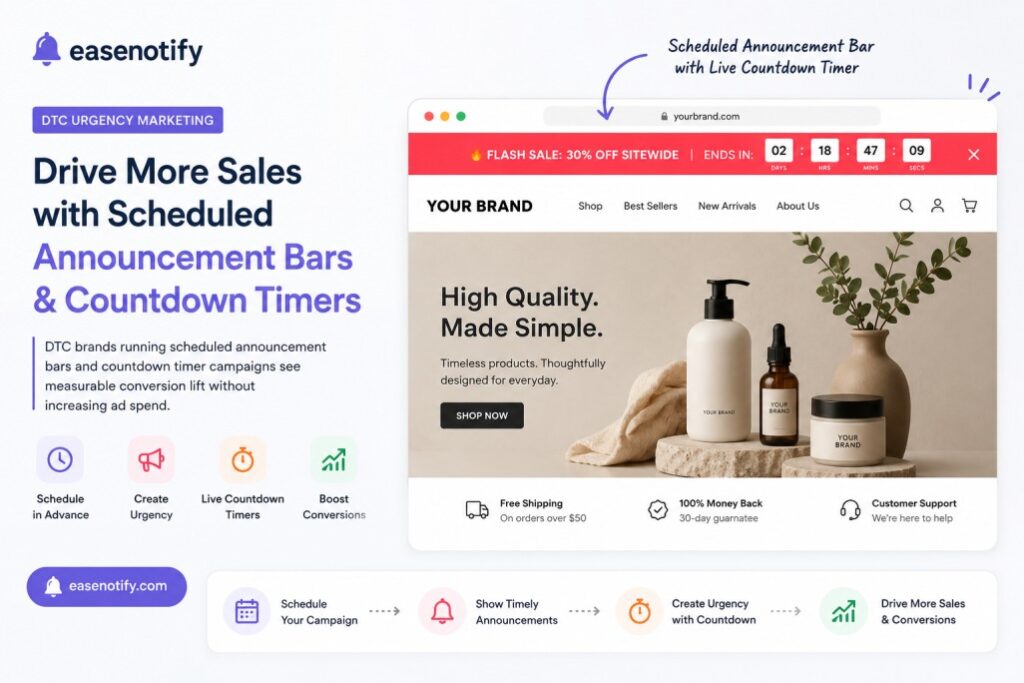
The infrastructure that delivers all four without developer dependency is a scheduled announcement bar and countdown timer system with page targeting built in.
How Top US and UK DTC Brands Use Urgency
The most successful DTC brands in both the US and UK have built urgency into their standard campaign operating rhythm. Understanding how they approach it reveals the patterns worth replicating.
US DTC Brands
Glossier (beauty, New York) built its brand on low-pressure discovery, but uses flash sale windows and restock drops as high-urgency conversion events that generate outsized revenue spikes within a limited window. Their product restock pages are among their highest-converting.
Allbirds (sustainable footwear, San Francisco) runs seasonal and end-of-line clearance campaigns with defined expiry dates. The time-bound nature of their promotions communicates environmental authenticity alongside scarcity — a dual urgency signal unique to their positioning.
Bombas (socks and apparel) uses threshold-based messaging heavily, with free shipping incentives surfaced at the top of the cart experience. Their average order value reflects this: customers routinely add a second item to cross the shipping threshold.
Ritual (supplements and vitamins) uses launch-day urgency for new product introductions, with countdown sequences on pre-launch product pages that build waitlist demand before a single unit ships.
MVMT (watches and accessories) runs sitewide flash sales anchored to a specific sale window. The announcement bar is visible across every page of their storefront, ensuring that a visitor arriving on a blog post or collection page still sees the active promotion.
Dollar Shave Club (grooming, Los Angeles) applies urgency through introductory offer expiry — new visitor deals with countdown timers that create a first-session conversion pressure specific to acquisition campaigns.
Native (personal care, San Francisco) uses limited-edition seasonal product releases — pumpkin spice, holiday scents — as natural urgency events. Scarcity is built into the product strategy, and campaign bars amplify it at the site level.
UK DTC Brands
Gymshark (fitness apparel, Solihull) has perfected the limited-edition drop model. Their “Black Friday” events are planned months in advance and generate eight-figure revenue in a single day. The announcement bar running across their entire storefront during sale events is a central part of the campaign infrastructure.
Huel (meal replacement and nutrition, Tring) runs new product launch urgency with defined early-access windows for subscribers. Launch-day countdown timers appear on the product page before the SKU goes live, driving pre-launch engagement.
Graze (snacks, London) uses free trial offer expiry as a conversion mechanism. The announcement bar communicates that the free trial is a limited-time entry point, creating urgency for first-time visitors who might otherwise browse and leave.
Wild (sustainable deodorant, London) runs seasonal product and scent launches with restock urgency for sold-out lines. Their customer base is loyalty-heavy, and restock alert campaigns drive immediate conversion from warm audiences.
Bloom and Wild (gifting and flowers, London) uses date-based urgency tied to delivery cutoffs for seasonal gifting moments — Valentine’s Day, Mother’s Day, Christmas. A “Order by midnight Thursday for delivery before Mother’s Day” announcement bar is not a gimmick; it is critical information that drives same-session purchases.
The pattern across all thirteen brands is the same: urgency is not a tactic applied randomly. It is a campaign discipline tied to specific moments — launches, restocks, promotions, and seasonal events — communicated through persistent, scheduled on-site messaging.
The 7 Urgency Campaigns Every DTC Brand Should Run
Campaign 1: Flash Sale Announcement Bar
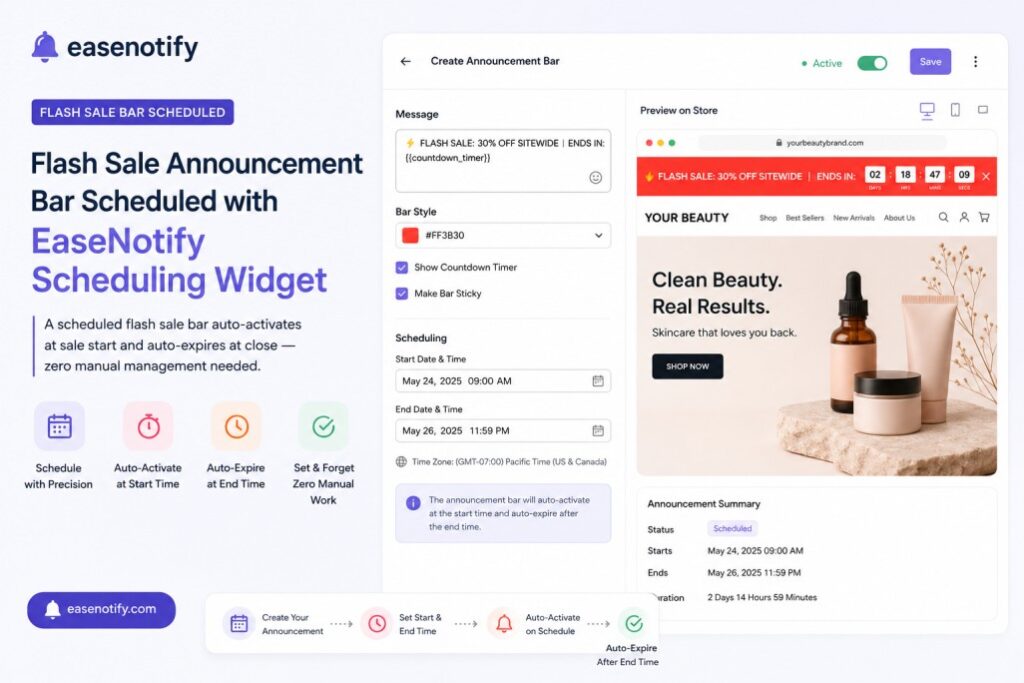
The flash sale announcement bar is the highest-ROI urgency campaign available to DTC brands. Placed at the top of the storefront as a sticky bar, it displays the time-limited offer across every page of the site — not just the product page a customer lands on.
For fashion brands like MVMT and beauty brands like Glossier, flash sales are a primary revenue lever. Without an announcement bar, a customer who arrives on a blog post or collection page during a sitewide sale may never see the offer.
Example message: “48-Hour Sale — 20% Off Sitewide. Ends Sunday at Midnight. Shop Now.”
Using EaseNotify’s Scheduling Widget, the bar goes live at the exact start of the sale and auto-expires at close. No manual toggling at midnight. No forgotten “20% off” bar running three days after the event ended.
Campaign 2: Countdown Timer for Product Launches
Product launches are high-stakes revenue moments for DTC brands. The window between “launching soon” and “live now” is where the most valuable pre-launch behavior happens: email sign-ups, social shares, and early purchases.
A countdown timer widget on the pre-launch product page creates anticipation and communicates that the moment has a defined start. For supplement brands like Ritual and fitness brands like Gymshark doing limited-edition releases, this campaign can sell the first batch before the official launch time.
EaseNotify’s countdown timer widget auto-hides once the launch time passes, keeping the page clean without any manual cleanup.
See the most effective countdown timer configurations at Best Countdown Timer Widgets for E-commerce: 7 Tools That Drive Real Urgency in 2026.
Campaign 3: Low Stock Alert Bar
“Only 7 left in stock” is one of the highest-converting sentences in DTC ecommerce. The low stock alert bar surfaces that scarcity signal in a persistent top bar visible from any section of the site — not buried in product description text the visitor may never reach.
For gadget stores and pet brands with genuinely limited inventory, this campaign works because it is honest. For skincare brands after a press mention or social spike, it communicates authentic demand.
Using EaseNotify’s Page Targeting feature, the low stock alert bar appears only on the specific product pages where stock is genuinely low. A sitewide “Low Stock” bar on every product dilutes the signal into meaninglessness within a week.
Campaign 4: Free Shipping Threshold Bar
The free shipping bar is the most reliable average-order-value increaser available to DTC brands. According to HubSpot’s ecommerce marketing research, free shipping is the number one incentive that drives shoppers to complete a purchase.
The bar shows the gap between the customer’s current cart value and the shipping threshold in real time: “You are $12 away from free shipping.” Bombas uses this mechanism extensively, and it is a primary reason their average order value stays above the industry median.
For DTC brands in beauty, fashion, and fitness, this single campaign consistently increases order values. Customers add one more item not because of a discount but because the math makes sense to them.
Full configuration guide and strategies: Free Shipping Bar: 7 Strategies That Increase Average Order Value by 30%.
Campaign 5: Cart Abandonment Recovery Bar
Cart abandonment averages 70 percent across ecommerce. For DTC brands running paid acquisition, this is the most painful number in the business: a customer who clicked the ad, browsed the product, added to cart, and still left.
A sticky exit-intent bar is the last in-session intervention before the customer closes the tab. A well-timed message — “Still thinking? Your cart expires tonight. Complete your order now.” — can recover a meaningful percentage of those sessions before they leave, without waiting for an email re-engagement sequence.
This is where urgency marketing for DTC brands makes its most direct economic argument. The customer is already warm. EaseNotify Pro costs $6 per month. A single recovered $60 cart covers the annual subscription.
Campaign 6: Seasonal and Holiday Sale Campaign Bar
Black Friday. Cyber Monday. Valentine’s Day. Mother’s Day. For DTC brands in fashion, beauty, and gifting categories, these moments drive a disproportionate share of annual revenue. Bloom and Wild builds their entire Q1 strategy around delivery cutoff urgency for seasonal gifting occasions.
The operational challenge is managing 8 to 12 campaigns across a full promotional calendar without constant manual intervention.
EaseNotify’s Scheduling Widget solves this exactly. Build all seasonal campaigns in advance, set the start and end timestamps for each, and every bar goes live and expires automatically. A full promotional calendar for a DTC brand can be configured in one session — and run itself for the rest of the year.
Campaign 7: New Collection Drop Bar
DTC fashion brands and beauty brands run collection drops as a primary growth mechanism. The new collection drop bar is a sitewide announcement bar that runs for the first 48 to 72 hours of a new collection’s availability, communicating that it is live, new, and potentially limited.
Gymshark’s drop model and Wild’s seasonal scent launches both follow this pattern: a defined window of heightened attention that urgency bars amplify across the entire storefront.
This campaign does not require a discount. The urgency is the freshness — “Our Summer Collection just dropped. Shop before your size sells out.” Combined with EaseNotify’s Remember Dismissal feature (which prevents the bar from reappearing to users who already dismissed it), this campaign communicates without annoying returning visitors.
30+ announcement bar message templates for DTC campaigns: Announcement Bar Messages That Get Clicked: 30+ Templates by Category.
How EaseNotify Powers Urgency Campaigns for DTC Stores
EaseNotify is a lightweight website notification and announcement bar tool built for DTC brands and Shopify stores that need to launch urgency campaigns without developer involvement.
At $6 per month for the Pro plan, it is the lowest-cost conversion infrastructure available for DTC ecommerce. There is no plugin bloat, no performance impact, and no technical setup beyond a single script installed in your theme header.
The specific features that make EaseNotify the right tool for urgency marketing for DTC brands:
- Scheduling Widget: Set any campaign to go live and auto-expire at specific times. Run your Black Friday bar without touching the dashboard at midnight.
- Page Targeting: Show the low stock alert only on the product page where stock is genuinely low. Show the cart abandonment bar only on cart and checkout pages.
- Countdown Timer Widget: Add a live countdown clock to any announcement bar for time-based urgency campaigns.
- Auto-close Widget: Bars that auto-dismiss after a set duration, reducing visual noise without requiring the visitor to manually close them.
- Sticky Widget: Bars that stay visible as the visitor scrolls, maximizing campaign visibility throughout the session.
- Remember Dismissal: Prevents returning visitors from seeing the same bar again after they have dismissed it, protecting the experience for loyal customers.
For a full overview of on-site notification bar types available to DTC stores: Ecommerce Notification Bar: 9 High-Converting Types Every Store Needs.
Setting Up Your First Urgency Campaign in 60 Seconds
- Create a free account at easenotify.com.
- Click “Create Widget” and choose Announcement Bar or Countdown Timer.
- Enter your campaign message — use one of the flash sale message templates from Announcement Bar Messages That Get Clicked.
- Set the start and end timestamps using the Scheduling Widget.
- Set Page Targeting if the campaign is specific to a product or cart page.
- Copy the install script and paste it into your Shopify theme’s header section.
- Preview on desktop and mobile, then activate.
The full setup takes under two minutes for a first-time user. For an existing account where the script is already installed, launching any new urgency campaign takes under 60 seconds.
More on selecting the right website widgets for your DTC store: Website Widgets for Ecommerce: The 3 Tools That Turn Browsers Into Buyers.
Urgency Marketing Mistakes That Kill DTC Conversions
Running urgency campaigns sitewide without page targeting. A “Last Chance” bar on your About page trains visitors to ignore all your bars within two visits. Use Page Targeting to show campaign bars only where they are contextually relevant.
Using fake urgency. A countdown timer that resets on every page refresh is visible to any visitor who tries it. Fake urgency destroys the brand trust that DTC brands spend significant budget building. Run authentic urgency tied to real sale windows, real inventory, and real thresholds.
Launching without a message test. The bar copy matters more than the design. Two different messages on the same offer can produce dramatically different click-through rates. Test two message variations over 48 hours before scaling a campaign.
Ignoring mobile. According to Think with Google, more than 60 percent of ecommerce browsing happens on mobile. An announcement bar that breaks the mobile layout or is impossible to dismiss on small screens increases bounce rate, not conversions. Test every campaign on mobile before activating.
Not setting an expiry. A flash sale bar running three days after the sale ended is a brand credibility problem. Always use the Scheduling Widget to set an end time for every campaign — without exception.
Frequently Asked Questions (FAQs)
Q: What is urgency marketing for DTC brands?
Urgency marketing for DTC brands is the practice of using time-sensitive, scarcity-based, or threshold-driven on-site campaigns to accelerate purchase decisions. It uses announcement bars, countdown timers, and targeted notification widgets to trigger buying behavior from visitors already on the site, without additional ad spend.
Q: Do urgency campaigns actually increase DTC conversion rates?
Yes. Time pressure and scarcity are documented behavioral drivers in ecommerce. When urgency campaigns are authentic — tied to real sale windows or real stock levels — and properly targeted using page-level display logic, they consistently lift conversion rates for DTC brands across fashion, beauty, supplements, fitness, and pet categories.
Q: How is EaseNotify different from other popup tools for DTC stores?
EaseNotify is not a popup tool. It is a lightweight notification and announcement bar platform designed specifically for DTC campaign management. Unlike generic popup builders, EaseNotify includes a Scheduling Widget for automated campaign timing, Page Targeting for contextual display logic, and a Countdown Timer for time-based urgency — all without developer setup, at $6 per month.
Q: Which DTC niches benefit most from urgency marketing?
Fashion brands, beauty brands, skincare brands, supplement companies, gadget stores, pet brands, and fitness brands see the highest lift. These niches share high repeat-purchase potential, seasonal sale moments, and product launch cycles that urgency campaigns amplify directly.
Q: How much does EaseNotify cost for DTC brands?
EaseNotify has a free plan (1 widget, 500 monthly views) suitable for testing a first campaign. The Pro plan is $6 per month and includes unlimited widgets, unlimited views, all scheduling and targeting features, and support across Shopify, Webflow, WordPress, and WooCommerce.
Q: Can I run urgency campaigns on Shopify without a developer?
Yes. EaseNotify requires only a single script installed in your Shopify theme header. Once installed, you create, schedule, target, and deactivate urgency campaigns from the EaseNotify dashboard with zero code.
Q: What announcement bar message works best for DTC flash sales?
Short, direct messages with a defined end time consistently outperform generic discount announcements. “48-Hour Sale: 20% Off Sitewide. Ends Sunday at Midnight.” performs better than “Big Sale On Now!” because it gives the visitor specific information that creates a real cost to waiting. See the full template library: Announcement Bar Messages That Get Clicked.
The 7-Campaign Action Plan
Urgency marketing for DTC brands is not a one-time tactic. It is a campaign infrastructure that runs in parallel with every sale event, product launch, and seasonal moment your brand operates around.
The seven campaigns above cover the full lifecycle of DTC urgency: acquisition (flash sale bar), retention (free shipping bar), recovery (cart abandonment bar), and loyalty (launch day drop bar).
For context on how all these campaigns fit within a broader conversion optimization strategy, see Increase Shopify Conversion Rate: 11 DTC Strategies That Work Without More Ad Spend.
EaseNotify gives you the infrastructure to run all seven at $6 per month.
Start with the free plan. Build your first campaign this week. Upgrade to Pro when you are ready to schedule your first automated campaign.
Create Your Free Urgency Campaign at easenotify.com
Want more? Upgrade today to the PRO version.
Last updated: May 2026
7 thoughts on “Urgency Marketing for DTC Brands: 7 Campaigns That Convert Without More Ad Spend”