
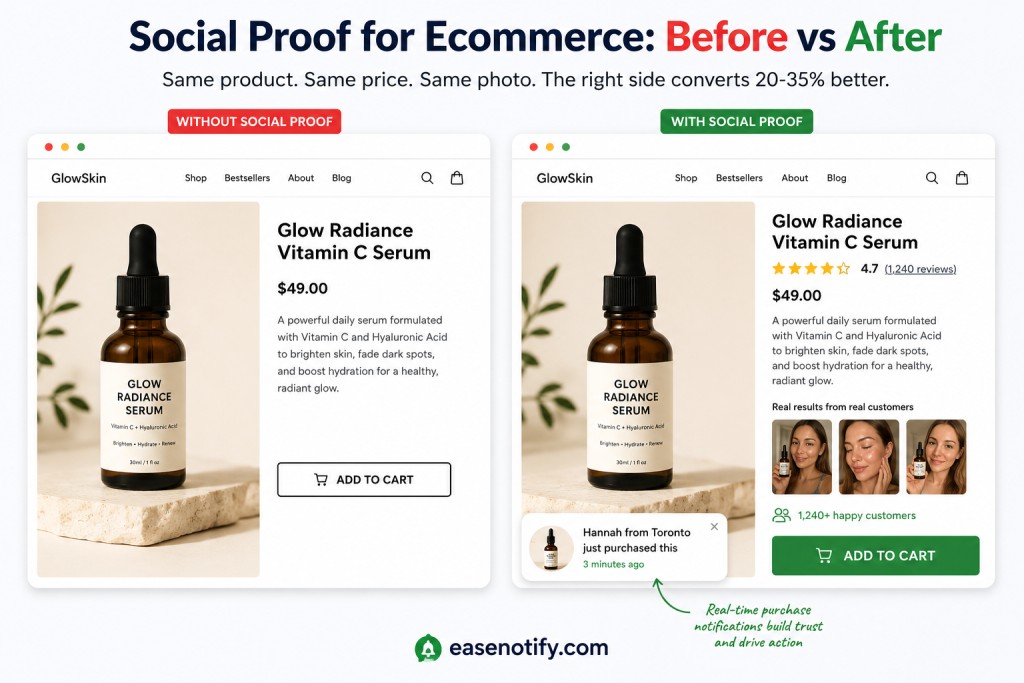
Social proof for ecommerce is the single most researched conversion lever in digital retail — and also the most unevenly deployed. Most stores have some form of it. Almost no stores have all of it, placed correctly, on the right pages, matched to what hesitant buyers actually need at each stage of the purchase decision. That gap is measurable. A Shopify store implementing comprehensive social proof consistently sees conversion rate improvements of 20 to 35 percent according to easyappsecom.com’s 2026 Shopify social proof guide.
The average Shopify store converts at 1.4 percent. The top 10 percent convert at 4.7 percent or higher. Social proof is a primary driver of that gap.
This guide covers all seven types of social proof for ecommerce ranked by documented conversion impact, how the best D2C brands deploy them, where to place each type by page, and how to combine them for compounding effect.
Key Takeaways
- Social proof for ecommerce is not one tactic. It is a stack. Stores that implement multiple types simultaneously see 20-35% overall conversion rate improvements. Stores that rely on a single type see smaller, more fragile gains.
- Real-time purchase notifications deliver the highest documented conversion lift at 10 to 32 percent on product pages, with some implementations reporting up to 98 percent on high-intent pages according to foursixty.com’s ecommerce analysis.
- 92% of consumers hesitate to purchase when reviews are missing according to wiserreview.com’s 2026 data. Products with five or more reviews are 270% more likely to be purchased.
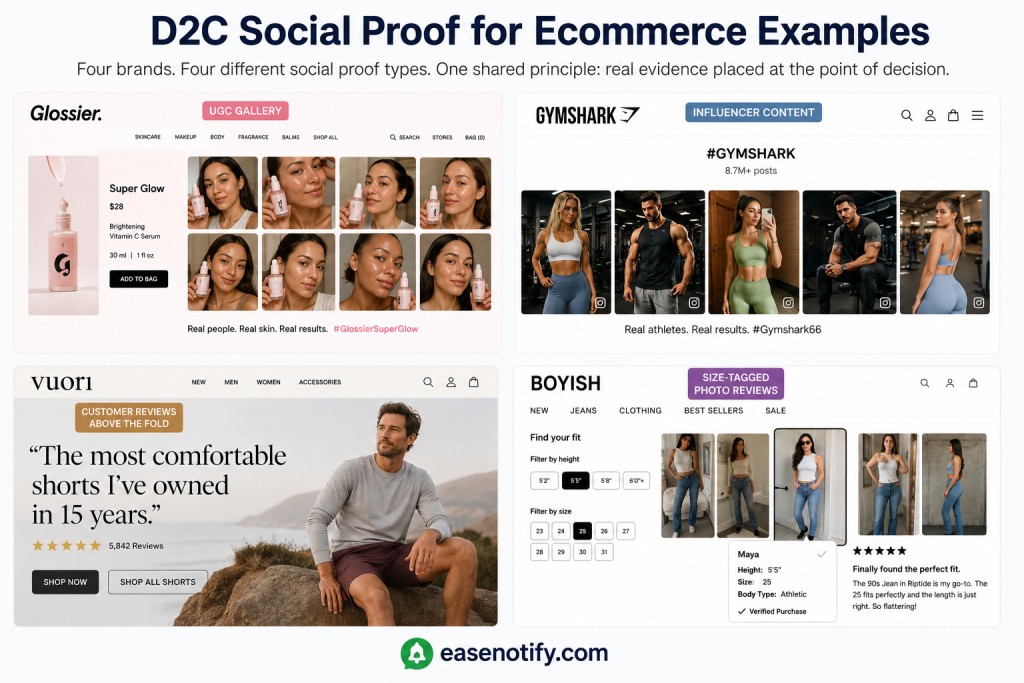
- Brands like Glossier, Gymshark, and Vuori built their conversion foundations on social proof — not ads. Each uses a different type matched to their product category and customer psychology.
- 60% of all ecommerce sales now happen on mobile according to redstagfulfillment.com’s 2026 data. Social proof designed for desktop only captures less than half your audience.
- Loss aversion doubles the power of social proof when combined with scarcity. Kahneman and Tversky’s research established that the pain of missing something is twice as powerful as the equivalent gain. “14 people are viewing this” hits twice as hard psychologically as “you could gain this.”
The Psychology Behind Social Proof (Why It Works Every Time)
Social proof is not a marketing trick. It is a hardwired cognitive shortcut. Robert Cialdini, in his foundational research on influence published in 1984, established that people look to the behavior of others when making uncertain decisions. His direct conclusion: “When we are unsure of ourselves, when the situation is unclear or ambiguous, when uncertainty reigns, we are most likely to look to and accept the actions of others as correct.”
Ecommerce is, by design, an uncertain environment. A first-time visitor to your Shopify store cannot touch the product, cannot ask a sales associate, and cannot see other customers shopping. Every purchase requires a leap of faith. Social proof is the bridge that makes that leap feel rational rather than risky.
Three psychological mechanisms drive social proof’s conversion power:
1. Social validation (Cialdini): People assume that popular choices are correct choices. A product with 1,200 reviews is implicitly more trustworthy than one with zero, regardless of the review content. The volume itself is the signal.
2. Loss aversion (Kahneman and Tversky): Losing something hurts approximately twice as much as gaining an equivalent reward feels good. When a visitor sees “31 people viewing this right now,” they are not thinking about gaining a product — they are thinking about potentially losing it to someone else. That asymmetry drives urgency.
3. Herd mentality: The bandwagon effect, documented in ScienceDirect’s consumer behavior research, shows that humans systematically overweight the choices of the crowd when facing ambiguous decisions. An online purchase is almost always an ambiguous decision for a new visitor.
These three mechanisms stack. A buyer who sees “1,200 reviews” (social validation) + “31 people viewing now” (loss aversion trigger) + “Bestseller in its category” (herd confirmation) is operating under all three psychological forces simultaneously. That is why comprehensive social proof stacks consistently outperform single-element implementations.
The 7 Types of Social Proof for Ecommerce Ranked by Conversion Impact
| Rank | Type | Avg. Conversion Lift | Best Placement |
|---|---|---|---|
| 1 | Real-time purchase notifications | 10-98% | Product page, cart page |
| 2 | Video testimonials | ~80% lift vs text | Product page, homepage |
| 3 | Customer reviews (volume + rating) | 270% more likely to purchase (5+ reviews) | Product page, checkout |
| 4 | User-generated content (UGC photos) | 29% better conversion, 5x vs pro photography | Product page, collection page |
| 5 | Live visitor counter | 21% bounce rate reduction | Product page (high-traffic), sale pages |
| 6 | Numerical social proof (“50,000+ customers”) | Up to 15% lift | Homepage, product page above fold |
| 7 | Trust badges and certifications | 42% checkout conversion lift | Cart page, checkout |
Type 1: Real-Time Purchase Notifications
Real-time purchase notifications show live order activity as it happens — “Sarah from London just purchased this — 4 minutes ago.” They convert at the highest rate of any social proof type because they deliver three signals at once: someone real bought this (validation), they bought it recently (recency), and they are identifiable (trust through specificity).
Foursixty.com’s ecommerce social proof analysis documents dynamic real-time social proof implementations achieving up to 98 percent conversion increases on high-intent product pages. Provesrc.com’s notifications research puts the more conservative average at 10 to 15 percent, rising to 32 percent for high-consideration products. Both datasets confirm the same directional finding: showing real purchase activity is the fastest conversion lever available.
The critical requirement is authenticity. Real-time notifications pulling live order data perform. Fake notifications cycling through invented names at fixed intervals are detectable and destroy trust instead of building it.
Type 2: Video Testimonials
Video testimonials outperform written reviews because they are nearly impossible to fake and because humans are wired to read faces. Wiserreview.com’s 2026 data shows 88 percent of consumers trust video testimonials as much as personal recommendations, and video format delivers 80 percent higher conversion improvement over text reviews.
The format matters more than production quality. A genuine customer filmed on a smartphone in natural lighting outperforms a polished agency-produced testimonial because authenticity is the point. UGC video from real customers is the most powerful form of video social proof available.
Type 3: Customer Reviews
Reviews are the foundation. Capitaloneshopping.com’s online review research reports that 98 percent of consumers read online reviews before purchasing, 92 percent hesitate when reviews are absent, and products with five or more reviews are 270 percent more likely to be purchased than products with zero. For higher-priced products, the conversion impact of reviews rises to 380 percent.
The review rating threshold matters. Purchase likelihood peaks at 4.2 to 4.5 stars rather than a perfect 5.0 — consumers interpret a perfect rating as suspicious, while a slightly imperfect score with a high volume signals authenticity.
Type 4: User-Generated Content (UGC Photos)
Foursixty.com reports that UGC is five times more effective than professional photography at influencing purchase decisions. Real customers using real products in real-world contexts remove the “it might look different in real life” objection that kills conversions on beauty, fashion, and home goods product pages.
Sites featuring UGC achieve 29 percent better conversion rates than those without. The Boyish Jeans model is exemplary: every review photo is tagged with the reviewer’s height, weight, and size, turning UGC into a fit-accuracy tool rather than just social proof.
Type 5: Live Visitor Counters
A live visitor counter shows the number of people currently on a page. It creates competitive arousal — the buyer sees that others are evaluating the same product right now and their desire to acquire it increases. Provesrc.com documents live visitor counters reducing bounce rates by up to 21 percent.
One important deployment rule: the visitor counter only creates urgency when the number is meaningful. Showing “2 people viewing this” on a quiet Tuesday does the opposite of its intent. Reserve the visitor counter for peak traffic windows and campaign days when concurrent visitor numbers naturally create genuine scarcity signals.
Type 6: Numerical Social Proof
“50,000+ happy customers,” “4.8 stars from 12,400 reviews,” “used by brands in 40 countries.” Volume numbers create instant credibility through sheer scale. Genesysgrowth.com’s 2026 conversion stats documents up to 15 percent conversion lift from displaying customer or follower counts prominently.
Numerical proof works best above the fold on product pages and in the hero section of the homepage, where it sets a credibility baseline before the visitor reads any product copy.
Type 7: Trust Badges and Certifications
Trust badges (secure checkout, SSL, money-back guarantee, payment logos) address a different category of anxiety than the other six types — not “is this product good?” but “is this transaction safe?” They function at the checkout stage and are most powerful there. Trust badges increase checkout conversions by 42 percent according to thegood.com’s placement research.
Trust badges do not drive discovery or product-page engagement the way higher-ranked types do. Placing them prominently on the homepage is largely wasted. Their ROI is in the cart and checkout flow.
How Real D2C Brands Use Social Proof (Named Examples)
Glossier — Community-First UGC Glossier built its entire product page strategy around unfiltered customer photos and selfies. Rather than replacing UGC with professional photography, Glossier treats customer images as the primary visual evidence. Every product page shows how real people with real skin use real Glossier products. The result, according to limely.co.uk’s ecommerce analysis, is a customer base that trusts Glossier recommendations as much as peer recommendations.
Gymshark — Influencer Volume as Social Proof Gymshark identified fitness influencers on YouTube and Instagram before influencer marketing was a recognized category, sending products for authentic coverage. The social proof strategy was not reviews — it was visible community belonging. Seeing thousands of athletes and gym-goers wearing Gymshark creates the same psychological effect as a packed restaurant: “if this many people chose it, it must be right.” Gymshark uses video testimonials and athlete social proof tied to the core emotion of community identity.
Vuori — Reviews in the Hero Vuori surfaces customer testimonials above the fold on every product page — not below the fold in a dedicated review section, but in the hero copy itself, replacing the brand-written tagline with real customer language. This placement decision reflects an important insight: reviews below the fold are read by buyers who are already considering. Reviews above the fold convert buyers who would otherwise have bounced. Getshogun.com’s DTC social proof examples cites Vuori as one of the clearest examples of social proof placed where the decision actually happens.
Boyish Jeans — Size-Specific UGC Fashion ecommerce loses conversions to fit uncertainty. Boyish Jeans solved this by tagging every customer review photo with the reviewer’s exact height, weight, and jean size. This turns the review gallery into a fit recommendation engine. A 5’4″ buyer can filter to photos from customers with the same measurements and see exactly how the jeans will look on them. Social proof with functional utility outperforms social proof as decoration.
Allbirds — Objection-Led Social Proof Allbirds uses social proof to address specific objections rather than simply validating the brand. Material explainers cite third-party sustainability certifications. Comfort claims are backed by customer language about specific sensations. Return policy prominence addresses purchase risk. Each piece of social proof is positioned against a documented buyer hesitation point, not just sprinkled across the page for vague reassurance.
Where to Place Social Proof: Page-by-Page Breakdown
The same social proof element placed on the wrong page underperforms significantly. Placement strategy is as important as the content.
| Page | Primary Anxiety | Best Social Proof Type | Placement |
|---|---|---|---|
| Homepage | “Can I trust this brand?” | Numerical proof, brand logos, overall rating | Hero section, above fold |
| Collection page | “Which product is right for me?” | Average rating per product, review count, bestseller labels | Below product image in grid |
| Product page | “Is this worth it? Will it work for me?” | Reviews, UGC, real-time notifications, video testimonials | Below title, above fold; notifications bottom-left |
| Cart page | “Should I go through with this?” | Trust badges, recent purchase notifications, testimonials | Near checkout button |
| Checkout page | “Is this transaction safe?” | Security badges, payment logos, delivery guarantee | Adjacent to payment form |
The most neglected placement is the cart page. Most stores invest heavily in product page social proof and then leave the cart page bare. Convertcart.com’s cart page research documents that a checkout confidence section — featuring a highlighted customer testimonial alongside trust badges — measurably reduces cart abandonment. Placing a recent purchase notification on the cart page restores the social validation that drove the visitor to add to cart in the first place.
For a step-by-step approach to page-specific messaging on Shopify, see our Shopify announcement bar page targeting guide, which covers how to show different content on different pages without code.
Combining Social Proof with FOMO and Urgency
Social proof and urgency marketing are not competing strategies. They amplify each other because they address different parts of the same hesitation.
Social proof answers: “Is this a good decision?” Urgency answers: “Do I need to make it now?”
A visitor who sees strong social proof but no urgency signal will often defer the purchase — “I’ll come back later.” A visitor who sees strong urgency but weak social proof may feel pressured rather than motivated. The combination — social proof that validates the decision plus urgency that activates it — produces the fastest purchase behavior.
The psychology is grounded in Kahneman and Tversky’s loss aversion research. Losing something hurts twice as much as gaining it feels good. When a visitor sees “31 people viewing this now” alongside a “Ends in 2:47:03” countdown timer, two distinct psychological forces activate simultaneously:
- The social proof (31 viewers) signals demand, which creates the possibility of scarcity
- The countdown creates the actual scarcity deadline
- Loss aversion doubles the emotional weight of both signals
ConvertMate’s FOMO research confirms that FOMO messaging influenced a purchase decision for more than 6 in 10 consumers surveyed. A wellness brand cited in the research saw a 19 percent sales lift in 48 hours purely from urgency-based messaging during a limited sale.
The highest-converting combination for product pages:
- Reviews above the fold (social validation)
- Real-time purchase notification bottom-left (recent activity signal)
- Countdown timer in the announcement bar (urgency activation)
- Free shipping threshold bar (price hesitation removal)
These four elements address every major conversion barrier simultaneously without a single popup or interruptive element.
How EaseNotify Delivers Real-Time Social Proof
EaseNotify’s social proof widget delivers two of the seven types — real-time purchase notifications and live visitor counters — as non-interruptive bottom-left toast notifications. Both pull live data from connected platforms including Shopify, WooCommerce, and others.
The key differentiator in EaseNotify’s implementation is the unified dashboard. Most stores running social proof alongside announcement bars and countdown timers end up with three separate tools, three separate scripts, and three separate sets of page targeting rules. EaseNotify runs all three conversion layers from one platform with one lightweight script:
- Announcement bar at the top (offer communication)
- Countdown timer in the bar (urgency signal)
- Social proof notification at the bottom-left (purchase validation)
Page Targeting applies across all widget types — so the same rule that shows a free shipping bar only on product pages can also restrict the social proof notification to those same pages. No duplicate configuration, no conflicting scripts.
For a full breakdown of the social proof widget setup including notification timing, frequency rules, and platform connection, see our social proof widget for Shopify guide.
Social Proof Tool Comparison
| Tool | Social Proof Types | Free Plan | Starting Price | Shopify Native |
|---|---|---|---|---|
| EaseNotify | Real-time notifications, visitor counter + announcement bars, timers | Yes | $6/mo | Yes |
| WiserNotify | 50+ types: notifications, counters, reviews, FOMO | Yes | $16/mo | Yes |
| ProveSource | Notifications, visitor counts, conversion streaks | Yes (1K visitors) | $21/mo | Via embed |
| Nudgify | 10+ types: low stock, free shipping, reviews, counters | Free tier | $9/mo | Yes |
| Fomo | Notifications, full custom templates, 100+ integrations | No | $19/mo | Via embed |
Honest context: If your primary need is a full social proof platform covering all seven types — video testimonials, review aggregation, UGC feeds, numerical proof, and real-time notifications — WiserNotify or ProveSource are more comprehensive. EaseNotify is the right choice if you want real-time notifications and visitor counters integrated with your announcement bars and countdown timers in a single lightweight tool. Fewer moving parts, one script, lower page speed overhead.
Frequently Asked Questions (FAQs)
Q: What is social proof for ecommerce? Social proof for ecommerce is any element on your store that signals that other people have already made a positive decision about your product. It includes customer reviews, user-generated photos, real-time purchase notifications, live visitor counts, video testimonials, and trust badges. The mechanism is psychological: humans look to the behavior of others when uncertain, and an online purchase involves significant uncertainty. Comprehensive social proof reduces that uncertainty and closes the gap between browsing and buying.
Q: Which type of social proof has the highest conversion impact for ecommerce? Real-time purchase notifications have the highest documented conversion lift at 10 to 32 percent on average, with some high-intent product page implementations reporting up to 98 percent according to foursixty.com’s analysis. Video testimonials follow at approximately 80 percent improvement over text reviews. Customer reviews are the most widely deployed and produce a 270 percent higher purchase likelihood for products with five or more reviews versus zero.
Q: How many reviews does a product need before social proof becomes effective? The threshold is lower than most merchants expect. Wiserreview.com’s 2026 data shows that products with five or more reviews are 270 percent more likely to be purchased than products with none. The conversion lift continues to compound up to approximately 100 reviews, after which each incremental review has diminishing returns on conversion rate.
Q: Where should I place social proof on a Shopify product page? The highest-impact placement is above the fold, below the product title. This means the star rating and review count are visible before the visitor scrolls. Reviews themselves can sit lower on the page, but the summary signal (4.8 stars, 1,240 reviews) needs to be in the immediate viewport on load. Real-time purchase notifications should appear in the bottom-left corner after a 5 to 8 second delay. UGC photo galleries perform best directly below the product description. Trust badges belong at checkout, not on the product page where they are largely ignored.
Q: Does social proof work on mobile ecommerce? Yes, and it may matter more on mobile than desktop. Mobile now accounts for approximately 60 percent of all ecommerce sales according to redstagfulfillment.com’s 2026 data, yet mobile conversion rates are lower than desktop due to smaller screens, fragmented browsing sessions, and higher purchase anxiety on mobile. Social proof elements that are visible without scrolling — star ratings in the product title area, bottom-corner toast notifications — address mobile hesitation without requiring interaction. Bottom-left toast notifications are particularly effective on mobile because they sit in the natural scroll area without blocking product images.
Q: Can social proof work against you? Yes, in two specific scenarios. First, fake or staged social proof — invented review names, fictional purchase counts, static notifications that cycle identically — is detectable and destroys trust faster than no social proof at all. Second, low-engagement metrics displayed prominently hurt conversion. Showing “2 people viewing this” or “4 reviews, 3.1 stars” creates negative social signals. Only display social proof when the numbers are genuinely positive.
Start your free EaseNotify plan at easenotify.com. Real-time purchase notifications and live visitor counters — the two highest-impact social proof types for product pages — available alongside announcement bars, countdown timers, and page targeting in one dashboard.
Related reading:
3 thoughts on “Social Proof for Ecommerce: 7 Proven Types Ranked by Real Conversion Impact (2026)”