
Emotional appeal advertising is the practice of using feelings, not facts, to drive purchase decisions. The logic, the features, the specs: none of that closes a sale the way a precisely chosen emotion does.
This is not a creative preference. It is neuroscience. The limbic system, the part of the brain responsible for emotion, processes a message before the prefrontal cortex, the part responsible for logic, has time to evaluate it. Visitors feel your copy before they think about it. The question is whether you are writing copy that knows this.
Key Takeaways:
- Emotional appeal advertising works because the brain’s emotional processing system (limbic system) responds before rational evaluation begins.
- Emotional ads perform twice as well as rational-only ads, and purely emotional campaigns generate 31% higher profitability than rational campaigns (Nielsen).
- The 8 emotional appeal types are: happiness, fear, trust, nostalgia, belonging, inspiration, anticipation, and empathy. Each maps to a specific funnel stage and on-site placement.
- EaseNotify’s Page Targeting and Scheduling Widget allow emotional appeal copy to be delivered as announcement bars and notification tools on the exact page and at the exact session moment the emotion is most persuasive.
- The most common emotional marketing mistake is using emotional language without matching the emotion to the visitor’s current state in the purchase funnel.
What Is Emotional Appeal Advertising?
Emotional appeal advertising is a marketing strategy that targets a specific psychological response rather than presenting a logical argument for a product. Instead of stating what a product does, emotional appeal advertising communicates how owning or using the product will make the customer feel.
The underlying mechanism is well-documented. According to research by Harvard Business School professor Gerald Zaltman, 95% of purchasing decisions are made at the subconscious level. Rational copy, which lists features, compares specifications, and explains pricing tiers, arrives after the emotional decision has already been made or discarded. Emotional appeal advertising works upstream of that decision, at the moment the limbic system assigns meaning to a brand message.
Emotional appeal advertising is distinct from manipulative advertising in one critical way: it responds to emotions that the customer already holds in the context of the purchase. A customer shopping for life insurance already feels protective toward their family. Connecting the product to that existing emotion is not manipulation. It is relevance.
Why Emotional Appeals Outperform Rational Advertising
The performance gap between emotional and rational advertising is not subtle.
Research compiled by Nielsen across major advertising categories shows that emotional ads perform twice as well as ads with purely rational content. In brand lift specifically, purely emotional campaigns generate a 31% profitability increase compared to 16% for rational-only campaigns. The gap is consistent across categories, audiences, and channels.
The reason is structural. Rational advertising requires a visitor to process a claim, evaluate its credibility, compare it to alternatives, and make a judgment. That chain of cognitive steps takes time and effort, and most ecommerce visitors are not willing to invest either before deciding whether to stay on a page or leave.
Emotional advertising short-circuits that chain. When a visitor feels something in response to a message, they form an associative memory that links the feeling to the brand. That associative memory does not require re-evaluation on every return visit. It accumulates.
HubSpot’s data on personalization confirms that personalized CTAs, which are essentially emotional appeals calibrated to a visitor’s context, convert 202% better than generic ones. The emotional context is the conversion mechanism.
According to research published in the Harvard Business Review by Magids, Zorfas, and Leemon, fully connected customers are 52% more valuable on average than those who are merely highly satisfied. Rational satisfaction, meeting expectations, is not the same as emotional connection, which drives advocacy, loyalty, and repeat purchase. The revenue implication is direct: emotional copy is not a creative nicety. It is a commercial infrastructure decision.
8 Types of Emotional Appeals in Advertising (With On-Site Use Cases)
Not every emotion drives the same behavior. The eight types below are classified by the psychological response they activate, the funnel stage where they work best, and how they translate into on-site copy for ecommerce.
1. Happiness
Happiness-based appeals connect a brand with positive feeling, optimism, or delight. They work at the awareness stage, when a visitor is arriving with no prior intent, and the first message sets the emotional tone for the entire session.
Coca-Cola’s “The World Needs More Santas” campaign is the canonical example: the product is almost incidental. The emotion is primary. For ecommerce, happiness appeals appear in welcome bars (“Free shipping on your first order, no code needed”), positive reinforcement messages after cart additions (“Great choice. Arrives by Friday.”), and post-purchase confirmation messages that celebrate the decision.
2. Fear (FOMO and Loss Aversion)
Fear is the most powerful emotion in an ecommerce context. fMRI studies show the amygdala’s response to fear signals is approximately 3x stronger than its response to joy. Loss aversion, the behavioral economics principle that people feel losses roughly twice as intensely as equivalent gains, operates through the same mechanism.
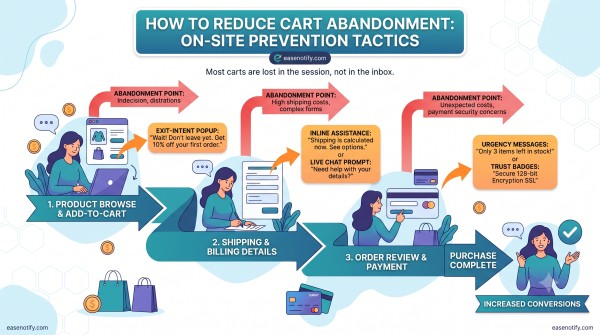
Fear appeals in ecommerce are most effective on product and cart pages, where a visitor is already considering a purchase. “Only 3 left in stock” activates scarcity fear. “Sale ends at midnight” activates time-loss fear. “67 people are viewing this right now” activates competitive fear.
For a full framework of fear-based urgency campaigns mapped to DTC store pages, see Urgency Marketing for DTC Brands: 7 Campaigns That Convert Without More Ad Spend.
3. Trust
Trust appeals do not create urgency. They remove resistance. They are most effective on product pages and during checkout, where purchase hesitation is highest and the cost of leaving is also highest.
Trust copy includes: free return policies stated plainly (“Free returns. No forms, no questions.”), guarantee framing (“If it doesn’t work, we’ll refund you instantly.”), and social proof in copy form (“Trusted by 43,000 customers since 2019.”). The Dove “Self-Esteem Project” campaigns are the macro-level equivalent: the brand’s entire positioning is a trust appeal built on transparency and genuine customer benefit.
4. Nostalgia
Nostalgia activates a specific psychological state: the warm, slightly melancholic feeling of something familiar from the past. It reduces skepticism and increases willingness to pay a premium because the emotional association bypasses price comparison.
Nostalgia appeals work on returning visitors and during product relaunch moments. “A fan favorite is back. Limited restock.” is a nostalgia appeal deployed as a single announcement bar line. Budweiser’s Clydesdales campaigns succeed for the same reason: the emotional anchor is shared memory, which cannot be priced or compared.
5. Belonging
Belonging appeals activate the social identity drive: the need to be part of a group of people who share values, aesthetics, or ambitions. Gymshark’s community-first marketing, Harley-Davidson’s owner culture, and Apple’s “Think Different” positioning all operate on belonging.
For ecommerce, belonging copy includes community language (“Join 40,000 people who already made the switch”), in-group framing (“Built for people who don’t settle for average”), and collective identity signals (“Our customers are people who actually use what they buy.”). Belonging appeals are most effective sitewide and in welcome messaging for new visitors.
6. Inspiration
Inspiration activates what psychologists call “elevation”: the emotional response to witnessing something excellent, virtuous, or aspirational. Nike’s “Dream Crazy” campaign (featuring Colin Kaepernick) is the clearest modern example. The product is peripheral. The emotion is aspirational identification.
Inspiration appeals are most effective for new visitor acquisition messaging and collection launches. “Built for people who push further” on a homepage announcement bar is an inspiration appeal. It does not describe the product. It describes the identity of the customer the brand believes in.
7. Anticipation
Anticipation is the emotional state of looking forward to something. It increases engagement, return visit rates, and the perceived value of the product before it is even available. Product drops, pre-orders, and waitlists all operate on anticipation.
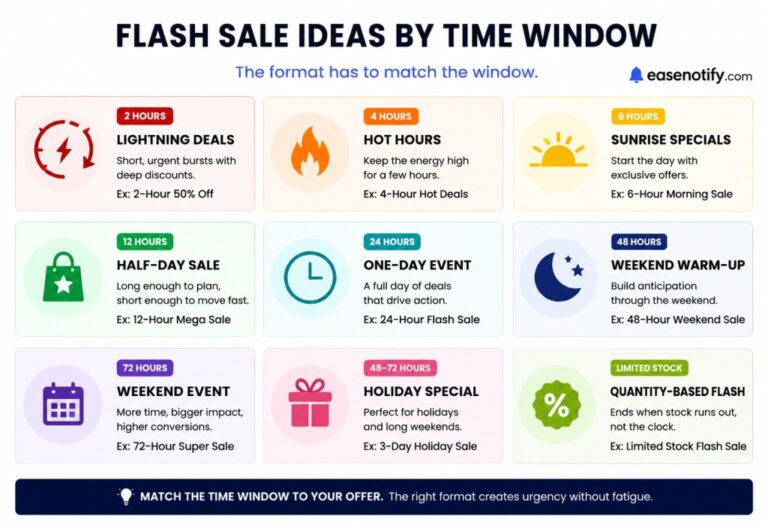
Announcement bars are particularly effective for anticipation appeals because they are the first message a visitor sees. “New collection drops Friday. Join the waitlist.” deploys anticipation as a conversion mechanism before the product exists. The emotion does the pre-selling. The EaseNotify Scheduling Widget makes it possible to swap a general homepage bar for a launch countdown bar at a precise time, with zero developer involvement.
8. Empathy
Empathy appeals work by demonstrating that the brand understands a specific pain, frustration, or need the customer holds. They are most effective in conversion copywriting where the visitor is evaluating whether the brand gets their situation.
Dove’s “Hard Knocks” film and McDonald’s “Knowing Their Order” campaign both succeed because the brand is not talking about the product. It is reflecting the customer’s own emotional experience back to them. In ecommerce, empathy copy sounds like: “Tired of returns that never arrive? We fix that with instant refunds.” or “Finding the right fit is hard. Our size guide gets you right first time.”
The Emotion-to-On-Site-Placement Matrix
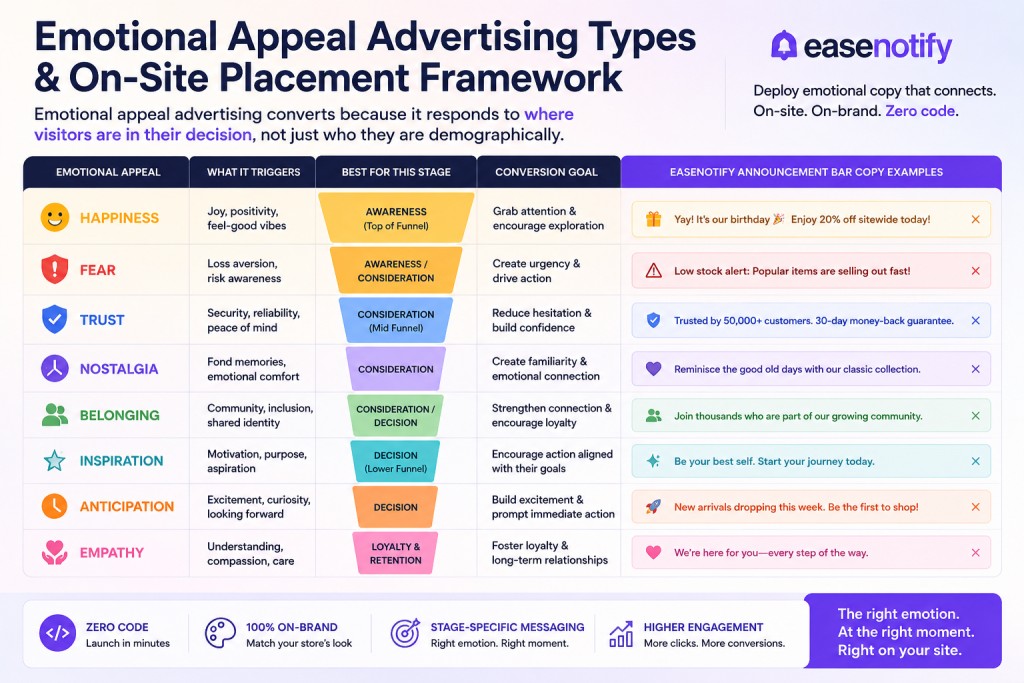
This is the framework no existing guide on emotional appeal advertising provides: a direct mapping from emotion type to the specific page, on-site tool, and announcement bar copy that deploys it most effectively.
| Emotion | Funnel Stage | Best On-Site Placement | EaseNotify Copy Example |
|---|---|---|---|
| Happiness | Awareness | Homepage / welcome bar | “Welcome. Free shipping on your first order. No code needed.” |
| Fear / FOMO | Decision | Product page + cart page | “Only 2 left. 18 people are viewing this now.” |
| Trust | Consideration | Product page / checkout | “Free returns on every order. No questions asked.” |
| Nostalgia | Consideration | Collection page / restock | “A fan favorite is back. Limited restock available.” |
| Belonging | Awareness / Loyalty | Sitewide bar | “Join 43,000 customers who already made the switch.” |
| Inspiration | Awareness | Homepage / category | “Built for people who don’t settle.” |
| Anticipation | Pre-purchase | Homepage / launch bar | “New collection drops Friday. Get early access.” |
| Empathy | Conversion | Cart / checkout | “Size not right? Free exchange. We make it easy.” |
Each row in this matrix represents a behavioral trigger that EaseNotify can deploy through Page Targeting, showing the correct emotional message only on the page where it will be most persuasive. No code required.
How EaseNotify Deploys Emotional Appeal Campaigns Without Code
EaseNotify is a website notification, widget and announcement bar tool for Shopify and web businesses. The connection between emotional appeal advertising theory and on-site execution is where most ecommerce stores lose the conversion: they understand the psychology but lack the delivery infrastructure.
EaseNotify closes that gap with features built for emotional appeal deployment:
- Page Targeting: Fear-based copy on product and cart pages only. Trust copy on checkout pages only. Happiness copy on the homepage only. Each emotional appeal reaches the visitor on the page where it is contextually correct, not broadcast indiscriminately.
- Scheduling Widget: Anticipation bars go live the moment a product drop window opens. Fear-based countdown timers appear only during sale periods. Empathy copy activates for visitors who have spent 90 seconds on a product page without converting.
- Countdown Timer: Pairs with fear and anticipation appeals to make time-based emotional pressure visible. “Sale ends in 4:32:17” is not just urgency copy. It is a visual representation of a fear appeal.
- Sticky Widget: Emotional copy that scrolls away from view as a visitor reads a long product description loses its impact at the moment of peak consideration. The Sticky Widget keeps the emotional message visible through the decision moment.
- Remember Dismissal: A visitor who dismissed a happiness-based welcome offer should not see it again on the same session. EaseNotify’s Remember Dismissal ensures the emotional experience stays positive and non-repetitive.
At $6 per month for the Pro plan, EaseNotify delivers a fully configurable emotional appeal campaign layer for any ecommerce store without requiring a designer, developer, or enterprise martech budget.
For a complete breakdown of which notification bar types serve each emotional function, see Ecommerce Notification Bar: 9 High-Converting Types Every Store Needs.
Emotional Appeal Mistakes That Kill Conversions
Emotional appeal advertising fails when the emotion is mismatched to the visitor’s current state, the copy is inauthentic, or the same emotional tone is applied everywhere regardless of context.
Using fear copy on a first visit. Fear and FOMO appeals are highly effective but require a prior relationship with the product. A visitor encountering a brand for the first time and immediately seeing “Only 2 left” perceives the message as pressure rather than information. Fear appeals perform best on return visits or after a visitor has spent meaningful time on a product page.
Applying the same emotion sitewide. A trust appeal on the homepage, a trust appeal on the product page, a trust appeal in checkout, and a trust appeal in the cart recovery email is not an emotional marketing strategy. It is a single emotional note played on repeat. Visitors who encounter varied, contextually appropriate emotional appeals across the purchase journey convert more and retain better.
Emotional copy without a clear action. Emotion activates. Action converts. An announcement bar that makes a visitor feel something but does not give them an immediate, specific thing to do loses the conversion the emotion created. Every emotional appeal needs a paired CTA: “Free returns on every order. Shop the new arrivals.”
Inauthenticity. The fastest way to destroy an emotional appeal campaign is to deploy an emotion the brand has not earned. A brand with 50 reviews claiming “Trusted by thousands” activates skepticism, not trust. Emotional appeals require congruence between the emotion claimed and the evidence available.
Ignoring funnel stage. Nostalgia appeals on a first visit from a cold traffic ad, or belonging copy to a returning customer on the cart page, represent emotional appeals deployed outside their effective funnel position. The Emotion-to-On-Site-Placement Matrix in this post exists to prevent exactly this mistake.
For more on how announcement bar copy and design decisions affect emotional response, see Website Announcement Bar: Why the Number 1 Conversion Tool on Your Site Is Probably Broken and Announcement Bar vs Popup: Which Converts Better for Your Store.
Frequently Asked Questions (FAQs)
Q: What is emotional appeal advertising? Emotional appeal advertising is a marketing approach that uses specific psychological emotions, such as fear, happiness, trust, or nostalgia, to influence purchase decisions. Rather than presenting rational arguments or product features, it communicates how a product or brand will make the customer feel, which drives faster decisions because emotional processing precedes rational evaluation in the brain.
Q: Why does emotional appeal advertising work better than rational advertising? Emotional appeals work faster. The limbic system, which processes emotion, responds to a message before the prefrontal cortex, which processes logic, completes its evaluation. Nielsen research shows emotional ads perform 2x better than rational ads, and purely emotional campaigns generate 31% higher profitability than rational-only approaches. Visitors make emotional decisions first, then justify them rationally.
Q: What are the 8 types of emotional appeals in advertising? The 8 types are: happiness (positive associations and delight), fear (FOMO, scarcity, loss aversion), trust (safety, reliability, transparency), nostalgia (familiar warmth from shared memory), belonging (community and shared identity), inspiration (elevation and aspiration), anticipation (excited expectation of something coming), and empathy (reflecting the customer’s own pain or experience back to them). Each type works best at a specific funnel stage.
Q: How do I use emotional appeal advertising in ecommerce announcement bars? Match the emotional appeal to the page and funnel stage. Use happiness appeals in homepage welcome bars. Deploy fear-based copy with countdown timers on product and cart pages. Place trust copy on product detail pages and checkout. Show belonging copy sitewide for brand positioning. Use EaseNotify’s Page Targeting to ensure each emotional message appears only on the page where its emotional context is most persuasive.
Q: Is emotional appeal advertising ethical? Yes, when it responds to emotions the customer already holds in the context of the purchase. A customer shopping for a baby product already feels protective. Connecting the brand to that emotion is relevance, not manipulation. Emotional marketing becomes unethical when it fabricates need, uses misleading scarcity, or exploits vulnerability. Using genuine scarcity data, real social proof, and earned trust claims keeps emotional appeal advertising honest and effective.
Q: What is the difference between emotional marketing and urgency marketing? Urgency marketing is a specific tactical execution of fear-based emotional appeals, using time pressure and scarcity signals to accelerate the purchase decision. Emotional appeal advertising is the broader psychological framework that encompasses all 8 emotion types across all funnel stages. Urgency is one instrument. Emotional marketing is the full orchestra. For the tactical urgency framework, see Urgency Marketing for DTC Brands.
Q: How do I measure whether emotional appeal advertising is working? Track conversion rate changes by page after deploying emotional copy, using A/B tests where one variant uses feature-first copy and the other uses emotion-first copy. Secondary signals include time-on-page (emotional copy tends to increase engagement), return visit rate, and cart-to-purchase conversion rate specifically on pages where fear or trust appeals are deployed. EaseNotify’s announcement bar click-through rate provides direct feedback on which emotional copy variants are resonating.
Most ecommerce stores are either writing pure feature copy or using emotional language at random. Neither approach works. The stores that convert consistently pick the right emotion for the right page and deliver it at the moment the visitor is deciding.
EaseNotify gives you the on-site infrastructure to do exactly that: page-targeted announcement bars, behavior-triggered countdown timers, and scheduling logic that deploys emotional copy at the conversion moment. Not everywhere. Not all the time. Where it matters, when it matters.
Start your free EaseNotify plan and deploy your first emotional appeal campaign today.