

Behavioral marketing is the practice of using what people do on your website to deliver the right message at the right moment. Not what they told you in a signup form. Not a demographic assumption. What they actually do: the pages they visit, the products they view three times, the cart they fill and abandon.
Every ecommerce store generates this data every day. Most ignore it completely.
Key Takeaways:
- Behavioral marketing converts because it responds to intent signals, not assumptions about who a person is.
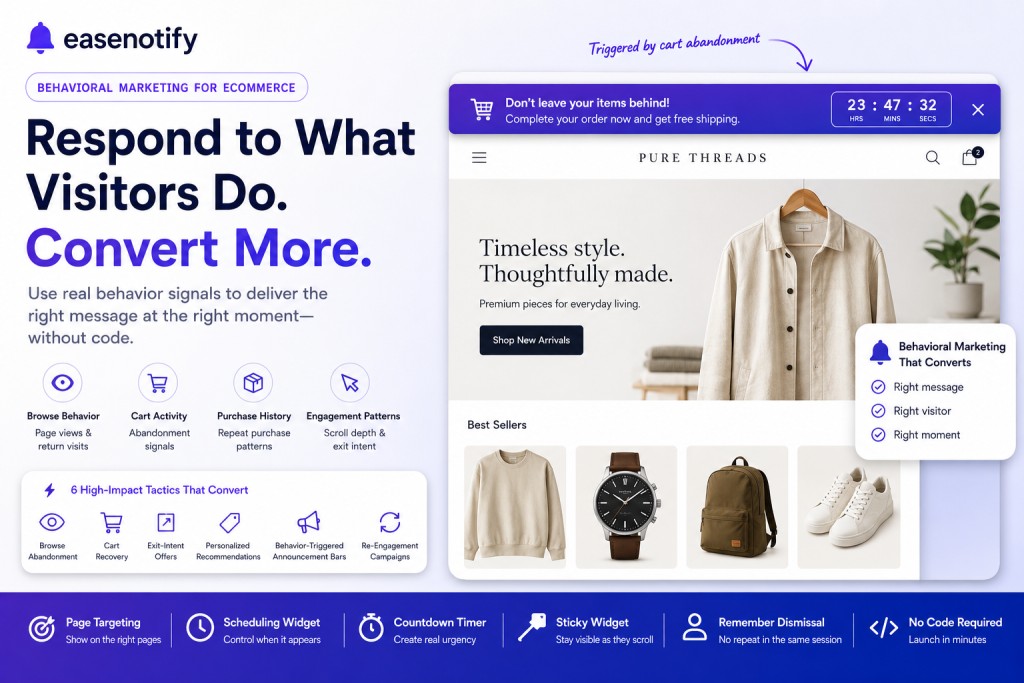
- The four behavioral data types that drive ecommerce conversions are browse behavior, cart activity, purchase history, and on-site engagement patterns.
- The six highest-impact behavioral marketing tactics include browse abandonment messages, cart recovery campaigns, exit-intent offers, personalized product recommendations, behavior-triggered announcement bars, and re-engagement campaigns for lapsed buyers.
- EaseNotify’s Page Targeting and Scheduling Widget deploy behavioral marketing as announcement bars and countdown timers on the exact pages and sessions that matter, with zero code.
- Start with cart recovery. It is your highest-intent behavioral signal and it requires only one campaign to capture.
What Behavioral Marketing Is (and What It Is Not)
Behavioral marketing is a targeting approach that uses observed user actions to personalize messaging, offers, and content in real time. Rather than grouping customers by age, gender, or location, behavioral marketing groups them by what they do: what they browse, what they add to cart, what they click, and what they ignore.
The core logic is direct. A visitor who has viewed the same jacket three times across two sessions is communicating purchase intent. A shopper who reaches the checkout page and leaves without completing the purchase is communicating hesitation. Behavioral marketing responds to both signals with precision and timing, rather than serving both visitors the same generic homepage banner.
What behavioral marketing is not: it is not ad retargeting alone, and it is not an email drip campaign running on a fixed schedule. Both tactics can incorporate behavioral data, but behavioral marketing as a discipline covers the full customer journey, including on-site behavior that happens in real time, before any email list is built or any retargeting pixel fires.
According to McKinsey, 71 percent of consumers expect personalized interactions from brands. Stores that respond to behavior are meeting that expectation. Stores that serve every visitor the same message are not.
Why Behavioral Signals Outperform Demographics
Demographics tell you who someone is. Behavior tells you what they want right now.
A 34-year-old in London who has visited your skincare product page twice in one session is more likely to convert than a 34-year-old in London who arrived from a generic brand ad and bounced in 10 seconds. Same demographic profile. Completely different intent. Only behavioral data captures that distinction.
HubSpot’s research on content personalization shows that personalized CTAs convert 202 percent better than generic ones. That gap exists because personalization based on behavior addresses the actual moment of decision, not a statistical average of customer characteristics built from survey data or third-party lists.
The shift from demographic to behavioral targeting is also more sustainable over time. With the deprecation of third-party cookies and tightening of privacy regulations under GDPR and CCPA, demographic data sourced from external platforms is becoming harder to acquire reliably. First-party behavioral data, generated by your own visitors on your own website, is not subject to the same restrictions. It is more accurate, more actionable, and it belongs entirely to you.
According to Salesforce research, 80 percent of customers consider the experience a brand provides to be as important as the product itself. Behavioral marketing is how you build that experience at the session level, where it matters most.
The 4 Behavioral Data Types That Matter for Ecommerce
Not all behavioral signals carry equal weight. The four data types below form the foundation of any ecommerce behavioral marketing program. Understanding the difference between a weak signal and a strong one is what separates effective behavioral marketing from noise.
1. Browse Behavior
Browse behavior tracks which pages a visitor views, how long they spend on each page, and how many times they return to the same product. A visitor who spends 90 seconds on a product page and then returns to it in a second session within 48 hours has communicated strong purchase intent without clicking a single add-to-cart button. That signal is actionable.
A homepage visit, by contrast, is a weak behavioral signal. Applying aggressive behavioral marketing interventions to homepage visitors misreads the data and wastes inventory.
2. Cart Activity
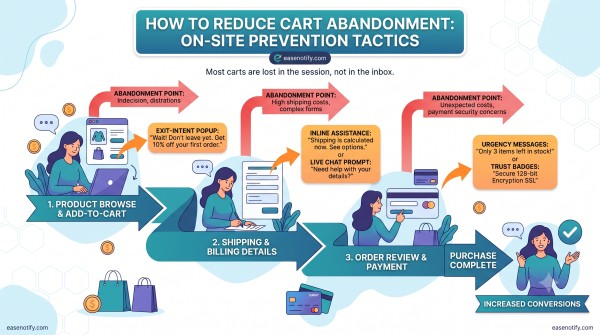
Cart data is the most direct intent signal available in ecommerce. A visitor who adds an item to cart and does not complete the checkout has self-identified as a high-intent shopper who needs one more reason to act. According to the Baymard Institute, the average documented cart abandonment rate is 70.19 percent. Every one of those sessions represents a behavioral signal waiting for a targeted response.
3. Purchase History
Past purchases predict future purchases. A customer who has bought from a specific product category twice is significantly more likely to respond to a third offer in that same category than a first-time visitor browsing broadly. Purchase history enables behavioral segmentation that targets repeat buyers with relevant re-engagement messages without wasting spend on generic promotional campaigns.
4. On-Site Engagement Patterns
Engagement patterns include scroll depth, click behavior on product images, time-on-page relative to content length, and exit-intent signals. A visitor who reads 80 percent of a product description before bouncing is at a different decision stage than one who arrives and leaves in 8 seconds. Engagement patterns reveal exactly where in the decision process a visitor stalls, which tells you where to intervene with behavioral marketing.
6 Behavioral Marketing Tactics That Convert
The following six tactics represent the highest-impact behavioral marketing implementations available to ecommerce stores without requiring an enterprise marketing stack. Each maps directly to a specific behavioral signal and delivers a response designed to move the visitor toward a decision.
1. Browse Abandonment Messages
When a visitor views a product page without adding to cart, they have expressed interest without commitment. A browse abandonment message delivered as an on-site announcement bar during the same session addresses this gap in real time, before the visitor leaves.
The message does not need to be aggressive. A bar that reads “Still thinking about this? Free shipping ends at midnight” gives the visitor a concrete reason to decide now without applying pressure. Delivered using EaseNotify’s Scheduling Widget to appear after 60 seconds on a product page, this approach converts passive interest into active consideration at the moment when behavioral intent is highest.
2. Cart Recovery Campaigns
Cart abandonment is the highest-value behavioral signal in ecommerce. A visitor who added to cart and did not complete checkout is one step from a conversion. That session deserves a direct behavioral response.
A cart recovery announcement bar with a live countdown timer, displayed on return visits or triggered by exit-intent on the cart page, uses the behavioral signal to create urgency around a real decision. “Your cart expires in 24 hours. Complete your order now.” This is behavioral marketing operating on the strongest intent signal in the funnel.
For a detailed breakdown of how countdown timers amplify cart recovery campaigns, see Best Countdown Timer Widgets for Ecommerce: 7 Tools That Drive Real Urgency in 2026.
3. Exit-Intent Offers
Exit-intent detection identifies the moment a visitor moves to leave the current page. Behavioral marketing treats this as an opportunity, not a failure. An exit-intent announcement bar delivers a contextual last-moment incentive calibrated to the specific page the visitor is leaving.
On a product page: “Wait. Get 10 percent off this item. Use code STAY10.” On a cart page: “Free shipping on this order. Claim it before you go.” The specificity of the offer to the behavioral context is what makes this work. A generic sitewide discount on an exit-intent has no behavioral relevance. A product-specific discount triggered only on the product page does.
EaseNotify’s Page Targeting ensures exit-intent messages appear only on the pages where the behavioral signal represents a real conversion opportunity. For a direct comparison of when to deploy bars versus popups for exit-intent scenarios, see Announcement Bar vs Popup: Which Converts Better for Your Store.
4. Personalized Product Recommendations
Browse and purchase history data powers product recommendation logic. Visitors who have viewed items in a specific category are shown related items based on that behavioral pattern, not on a generic bestseller algorithm applied to the entire catalog.
Behavioral recommendations outperform generic ones because they respond to expressed preference. A visitor who has viewed three minimalist watches does not want to be shown a feature-heavy chronograph. A customer who has purchased supplements twice does not need a notification about kitchen tools. Behavioral targeting surfaces the right product at the right moment because it has read what the visitor has already communicated.
5. Behavior-Triggered Announcement Bars
Announcement bars triggered by behavioral conditions are among the fastest-deploying behavioral marketing tools available to ecommerce stores. They require no developer, no tracking pixel setup, and no complex campaign workflow.
EaseNotify’s Page Targeting allows a store to show a specific announcement bar message only to visitors on a specific product page, a specific collection, or at a specific point in the checkout flow. A bar reading “Free returns on all outerwear this week” shown only to visitors on the outerwear collection page is behavioral marketing because it responds to a page-level intent signal. The same bar shown across the entire site at all times is broadcast marketing with extra steps.
The Remember Dismissal feature ensures a visitor who has already closed the bar does not see it again in the same session, removing friction without removing the opportunity for future sessions. The Sticky Widget keeps the message visible as the visitor scrolls through a long product page, preventing the behavioral prompt from disappearing before the intent signal peaks.
For more on how announcement bars function as conversion infrastructure when combined with targeting logic, see Website Announcement Bar: Why the Number 1 Conversion Tool on Your Site Is Probably Broken.
6. Re-Engagement Campaigns for Lapsed Buyers
Purchase history data identifies customers who converted once and have not returned. Behavioral marketing uses this signal to trigger re-engagement messages calibrated to what they bought and how much time has elapsed since their last purchase.
A customer who purchased a 30-day supplement supply 26 days ago has a high-probability repurchase window. A behavior-triggered message at day 25, “Ready to restock? Your last order runs out soon,” is behavioral marketing operating on purchase timeline data. This is distinct from a generic promotional campaign because the trigger is behavioral, not calendar-based. The result is a message that lands relevant, rather than random.
How EaseNotify Powers On-Site Behavioral Marketing
EaseNotify is a website notification and announcement bar tool for Shopify and web businesses. Its feature set maps directly to on-site behavioral marketing execution without requiring a developer, a data team, or an enterprise marketing platform.
The features that power behavioral marketing on EaseNotify:
- Page Targeting: Display a specific message only on specific pages. Cart recovery messages on the cart page only. Product-specific offers on product pages only. Collection-level promotions on collection pages only. This is the behavioral marketing layer.
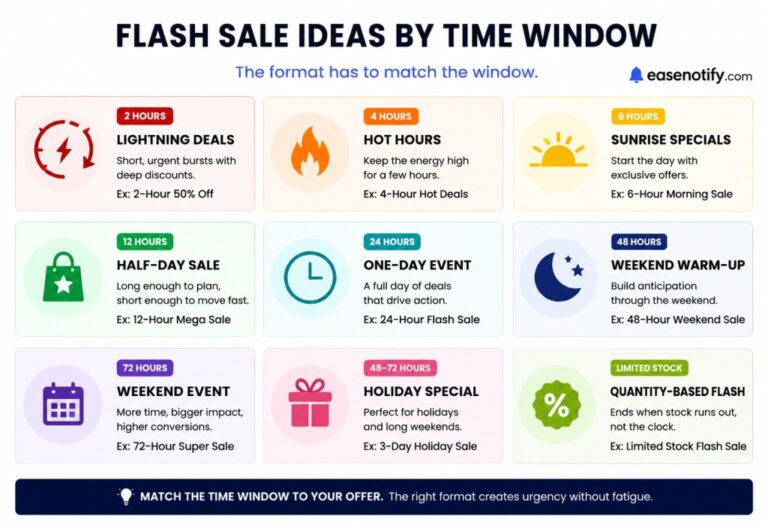
- Scheduling Widget: Control exactly when a message appears. After 45 seconds on a product page. On a visitor’s second session within 24 hours. At the start of a flash sale window. Timing is behavioral precision.
- Countdown Timer: Pair a time-sensitive offer with a live countdown to convert hesitant visitors before the behavioral window closes.
- Sticky Widget: Keep the message visible as the visitor scrolls through a long product description. Behavioral marketing fails when the prompt disappears before the visitor reaches peak intent.
- Remember Dismissal: A visitor who closes a message does not see it again in the same session. This prevents the friction that behavioral marketing is designed to eliminate.
- Auto-close Widget: Messages that auto-dismiss after a set duration reduce annoyance for visitors who have already made their decision, preserving the quality of the behavioral signal for future sessions.
At $6 per month for the Pro plan, EaseNotify delivers on-site behavioral marketing capabilities that enterprise platforms charge hundreds of dollars per month to provide.
For a complete breakdown of how to combine these features for a full ecommerce conversion strategy, see Increase Shopify Conversion Rate: 11 DTC Strategies That Work Without More Ad Spend.
Behavioral Marketing Mistakes That Kill Conversions
Behavioral marketing fails when the behavioral signal is misread, the response is poorly timed, or the same generic message runs regardless of page context. The most common mistakes:
Treating every page view as high intent. A homepage visit is a weak signal. A third visit to the same product page within 48 hours is a strong one. Applying aggressive behavioral interventions to weak signals trains visitors to ignore your messages before they reach the pages where intent is real.
Deploying behavioral messages without timing logic. Showing a cart recovery countdown to a visitor who added to cart 5 seconds ago is premature and counterproductive. Behavioral marketing requires a temporal dimension: how long, how recently, and how many times a behavior has occurred. EaseNotify’s Scheduling Widget solves this by setting appearance delays based on time-on-page or session count.
Showing the same message across all pages. Page Targeting exists precisely because a message without page context is not behavioral marketing. It is broadcast marketing with the word “personalization” attached to it. A free shipping offer shown on every page of the site carries no behavioral relevance. The same offer shown only on the cart page, only when cart value is below the free shipping threshold, does.
Ignoring what dismissal behavior is telling you. A visitor who closes a behavioral message three times across three sessions is communicating that the offer is wrong, the timing is wrong, or both. Remember Dismissal prevents repetitive annoyance, but the dismissal data itself is a behavioral signal that should inform offer testing.
Skipping the repurchase behavioral window. Most ecommerce stores apply behavioral marketing to acquisition sessions and ignore existing customers entirely. The repurchase window, identified through purchase history data, is the highest-margin behavioral segment available. It requires no ad spend and converts on relevance alone.
Frequently Asked Questions (FAQs)
Q: What is behavioral marketing in simple terms? Behavioral marketing is the practice of using what people do on your website, such as the pages they visit, the products they view multiple times, and the items they add to cart, to deliver personalized messages relevant to their current intent rather than their demographic profile.
Q: How is behavioral marketing different from traditional marketing? Traditional marketing targets audiences based on demographics: age, location, income bracket. Behavioral marketing targets based on observed actions during a live session or across sessions. A visitor who has viewed a product three times in two days is more likely to respond to a targeted offer than a visitor who matches a demographic profile but has shown no intent signals.
Q: Is behavioral marketing ethical? Behavioral marketing that uses first-party data, meaning data generated by visitors on your own website, is ethical and compliant with GDPR and CCPA when users are informed through a transparent privacy policy. The practice is designed to deliver more relevant messages and fewer irrelevant interruptions. Most customers experience it as better service, not surveillance.
Q: What behavioral marketing tools do ecommerce stores need? At minimum: an on-site behavioral response tool and email marketing automation. EaseNotify handles on-site behavioral responses through page-targeted announcement bars, countdown timers, and scheduling logic that triggers based on visitor behavior. For email behavioral automation, platforms like Klaviyo and ActiveCampaign complement EaseNotify’s on-site layer to cover the full funnel.
Q: How do announcement bars support behavioral marketing? Announcement bars deployed with Page Targeting and Scheduling logic function as behavioral marketing tools. A bar that displays a specific message only to visitors who have reached the cart page, or only during a visitor’s second session within 24 hours, is responding to behavioral data directly. For a full breakdown of notification bar types by behavioral use case, see Ecommerce Notification Bar: 9 High-Converting Types Every Store Needs.
Q: What is the fastest behavioral marketing campaign to deploy for an ecommerce store? Start with cart recovery. Cart abandonment is the highest-intent behavioral signal in your entire funnel and requires only one campaign: a page-targeted announcement bar with a countdown timer shown to visitors on the checkout page. Using EaseNotify, this campaign can be live in under 5 minutes. It captures the most valuable behavioral window before any other tactic is needed.
Q: How do behavioral marketing and urgency marketing work together? Behavioral marketing identifies which visitors to target and when. Urgency marketing provides the mechanism that accelerates the decision once a high-intent visitor is identified. The two strategies combine most effectively when urgency is applied selectively to high-intent behavioral signals, rather than broadcast across all sessions. For DTC-specific urgency campaign frameworks, see Urgency Marketing for DTC Brands: 7 Campaigns That Convert Without More Ad Spend.
Most ecommerce stores are sitting on behavioral data they never act on. Every product page view, every cart add, every session that ends without a purchase is a signal. Behavioral marketing is the discipline of responding to those signals with relevance and timing, rather than broadcasting the same message to everyone who visits.
EaseNotify gives you the on-site layer to act on behavioral signals in real time: page-targeted announcement bars, behavior-triggered countdown timers, and scheduling logic that delivers the right message at the exact moment a visitor is deciding. No developer required. No enterprise budget required.
Start your free EaseNotify plan and deploy your first behavioral marketing campaign today.

2 thoughts on “Behavioral Marketing for Ecommerce: 6 Tactics That Convert Based on What Visitors Actually Do”