
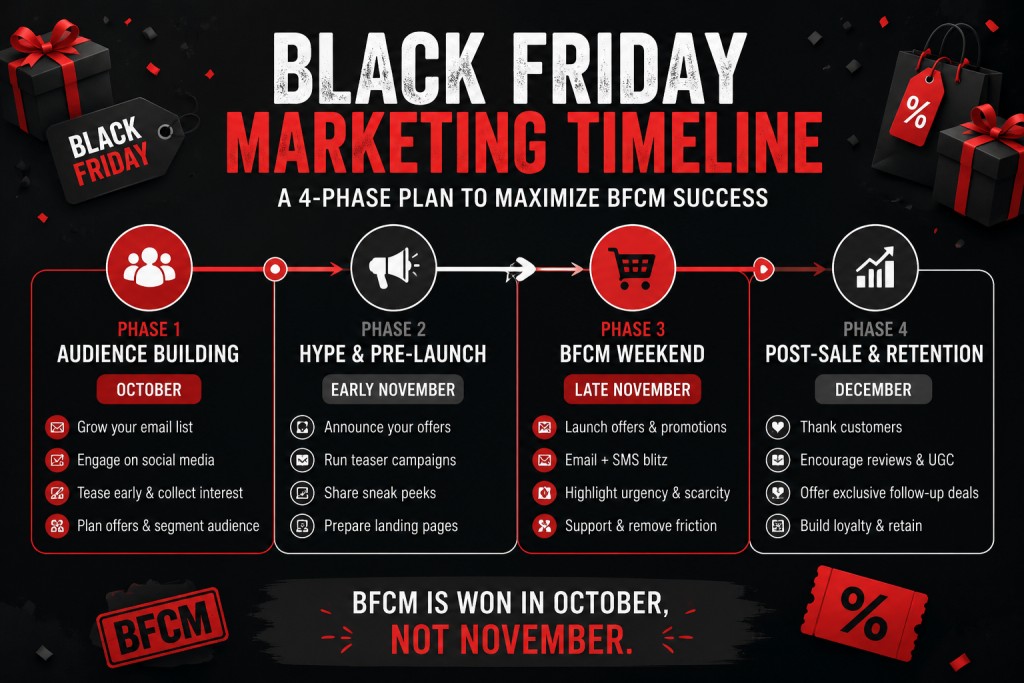
Searching for Black Friday marketing ideas in November is like training for a marathon the week before the race. The stores that win BFCM run a timeline, not a scramble: audience building in October, teasing in early November, a tightly run sale window, and a December plan for the buyers they just acquired. Here is that timeline, phase by phase.
Key Takeaways
- US shoppers spent a record $44.2 billion online across Cyber Week 2025, and mobile carried the majority of it. Your BFCM plan is a mobile plan.
- Winning stores run a 4-phase timeline: October audience building, early November teasing, the sale window itself, and December retention.
- Early access for subscribers is the highest-leverage BFCM idea: it grows your list in October and rewards it in November.
- Your announcement bar is BFCM mission control: it is the one message every visitor sees regardless of traffic source.
- Schedule every message start and stop in advance. During BFCM week you will not have time to manage banners manually.
What Makes Black Friday Marketing Different in 2026?
Black Friday is no longer a day. Adobe Analytics reported a record $44.2 billion in US online spend across Cyber Week 2025, with the buying stretched from early November through Cyber Monday and the majority of traffic arriving on mobile. The National Retail Federation counted nearly 200 million shoppers participating across the holiday weekend.
Two implications follow. First, discount visibility matters more than discount depth: shoppers compare dozens of stores in short mobile sessions, and the store that communicates its offer instantly wins the session. Second, because everyone is discounting, the pre-sale relationship (your list, your early-access audience) is the real competitive edge.
Phase 1: October, Build the Audience Before the Discount
Idea 1: Run an early-access signup campaign. The single best October move: a sitewide bar reading “Black Friday early access: join the list, shop 24 hours before everyone else.” You are converting cheap October traffic into an owned audience you will monetize in November. This works without popups; a persistent bar respects the browsing session, as covered in our popup alternative guide.
Idea 2: Audit and fix conversion leaks now. Every leak you fix in October pays out at BFCM traffic multiples. Start with the fundamentals in how to increase Shopify conversion rate.
Idea 3: Seed gift guides. Publish gift-guide content in October so it has time to index before “gifts for” searches spike.
Phase 2: Early November, Tease and Segment
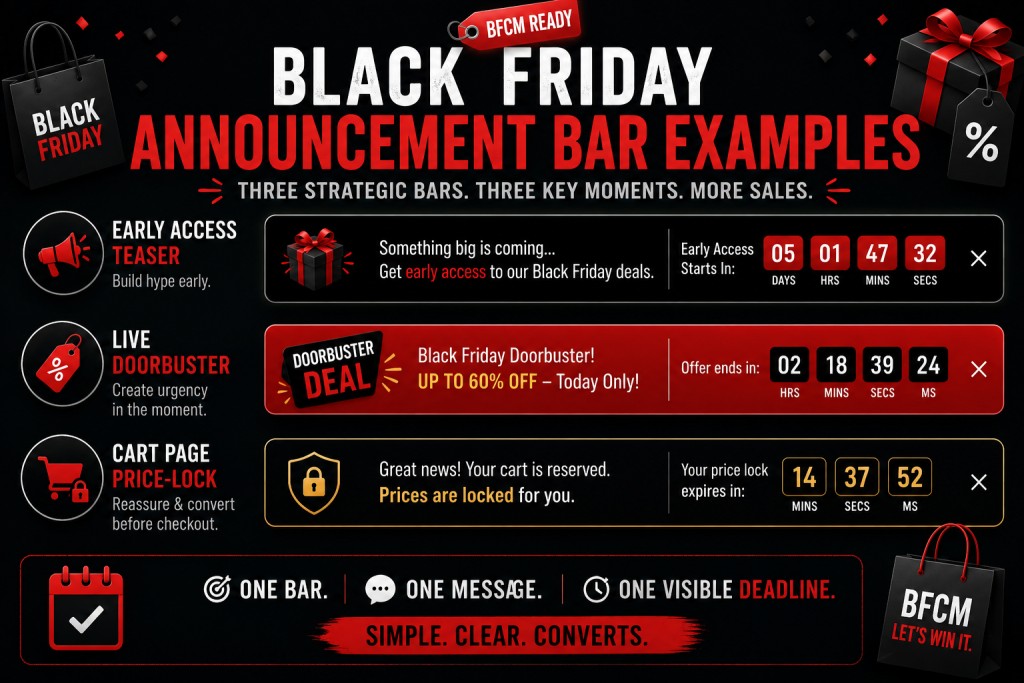
Idea 4: Announce the sale before it starts. A teaser bar with a countdown to the sale start (“Black Friday begins in 6 days”) builds anticipation and trains repeat visits. EaseNotify’s Scheduling Widget lets you build this in advance and let it flip to the live-sale message automatically at midnight.
Idea 5: Give the early-access list their window. Open the sale to subscribers 24 to 48 hours early. This rewards the October signups, spreads server and support load, and generates real “sold out” scarcity signals before the public window.
Idea 6: Publish your deal calendar. If you are running different offers on different days, say so up front. Transparency converts deal-hunters into planned repeat visitors instead of one-time bouncers.
Phase 3: BFCM Week, Run the Window
Idea 7: One sitewide bar, one message, one deadline. During the sale, your announcement bar carries the headline offer and a live countdown to the end of the current window. Concrete deadlines outperform vague ones, the same principle detailed in our flash sale ideas guide.
Idea 8: Rotate daily doorbusters. A different featured deal each day gives shoppers a reason to return all five days of Cyber Week. Update the bar copy daily; schedule all five variants in advance.
Idea 9: Defend the cart. BFCM shoppers abandon at even higher rates than the 70.19% Baymard Institute average because they are comparison shopping aggressively. Run a cart-page-only message with Page Targeting: “Your Black Friday price is locked for 30 minutes.” The full playbook is in how to reduce cart abandonment.
Idea 10: Raise the order floor. Pair the discount with a threshold: “Free express shipping over $100 all weekend.” BFCM’s elevated intent makes threshold laddering unusually effective; see our guide to free shipping thresholds and average order value for how to set the rungs.
Idea 11: Extend honestly or end honestly. A Cyber Monday extension is fine if you announce it as a distinct final window. What kills future urgency is the sale that quietly never ends. Hard-stop your banners with the Auto-close Widget and scheduled end times.
Phase 4: December, Convert the Sale Buyers You Just Won
Idea 12: Switch messaging from discount to deadline. After Cyber Monday, the urgency that matters is shipping cutoffs: “Order by December 18 for delivery before Christmas.” It is truthful, it converts, and it needs no margin sacrifice.
Idea 13: Welcome the new cohort. BFCM buyers are one-time deal hunters until you give them a second reason. A January early-access preview or a loyalty enrollment bar shown to returning visitors starts that conversion.
Idea 14: Collect feedback while it is fresh. A short post-purchase survey in December tells you what to fix before next year. Our website feedback widget guide covers formats that get response rates.
How Do You Keep the Site Fast Under BFCM Traffic?
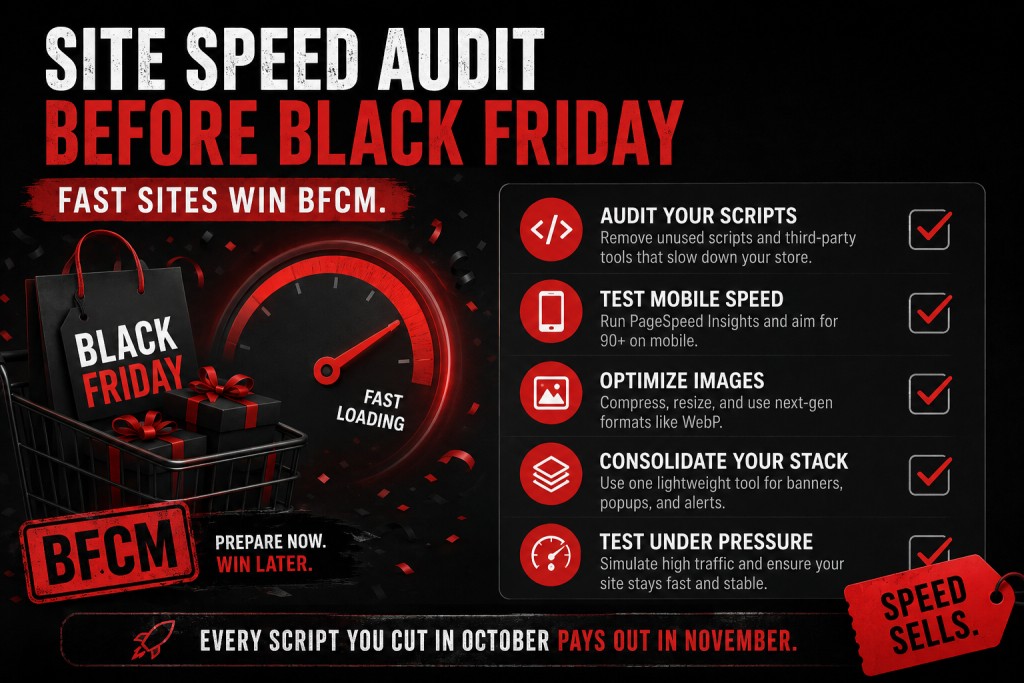
Every third-party script you add for the sale is weight your mobile visitors carry. Audit your app stack in October and cut what you do not need; our teardown of announcement bar page speed on Shopify shows the warning signs of a bar that is hurting Core Web Vitals.
This is also the reason to consolidate. EaseNotify is a website notification and announcement bar tool for Shopify and web businesses that covers banners, countdown timers, and website widgets in one lightweight script, replacing the three or four separate apps many stores bolt on for the season. At $6 per month for Pro, it also costs less than most single-purpose BFCM apps. You can also use third party free audit tools to check your site speed.
Frequently Asked Questions (FAQs)
Q: When should I start Black Friday marketing? A: Start in October. Use October to build an early-access list, fix conversion leaks, and publish gift content, then tease the sale in early November. Stores that begin marketing in mid-November compete on discount depth alone, which is the weakest position.
Q: What are the best Black Friday marketing ideas for small stores? A: Early-access lists, daily rotating doorbusters, threshold offers like free shipping over a set amount, and a sitewide announcement bar with a real countdown. These cost almost nothing and compete on communication quality rather than discount depth.
Q: How big should my Black Friday discount be? A: Shoppers expect meaningful cuts on featured items, typically 25 to 40%, but structure beats depth. Tiered offers, bundles, and free shipping thresholds protect margin while still reading as significant Black Friday value.
Q: Should Black Friday and Cyber Monday have different offers? A: Yes, distinct windows with distinct framing. Run the headline discount through the weekend, then position Cyber Monday as a final, clearly labeled last-chance window. Announce each transition so deadlines stay credible.
Q: Do announcement bars work better than popups for Black Friday? A: For sale communication, yes. A persistent bar is visible in every session without blocking mobile screens during your highest-traffic week, while popups interrupt and get dismissed. Use the bar for the offer and deadline, and reserve any popup use for exit intent.
BFCM rewards the stores that plan in phases and communicate relentlessly. Build your October list bar, schedule your November windows, and let the tooling run the calendar. EaseNotify handles the entire on-site layer, free to start, $6 per month for Pro.
Start your free EaseNotify plan at easenotify.com.