
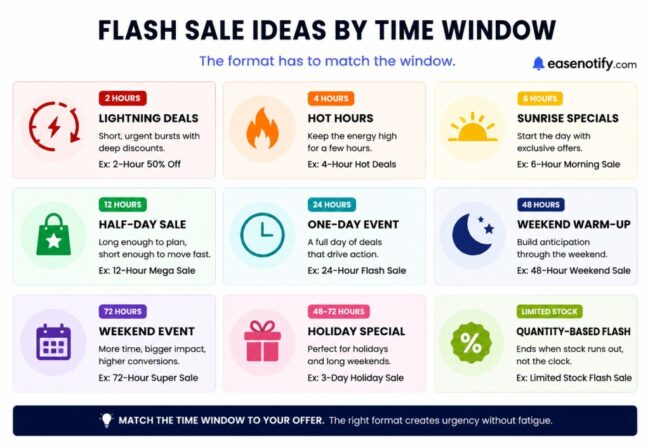
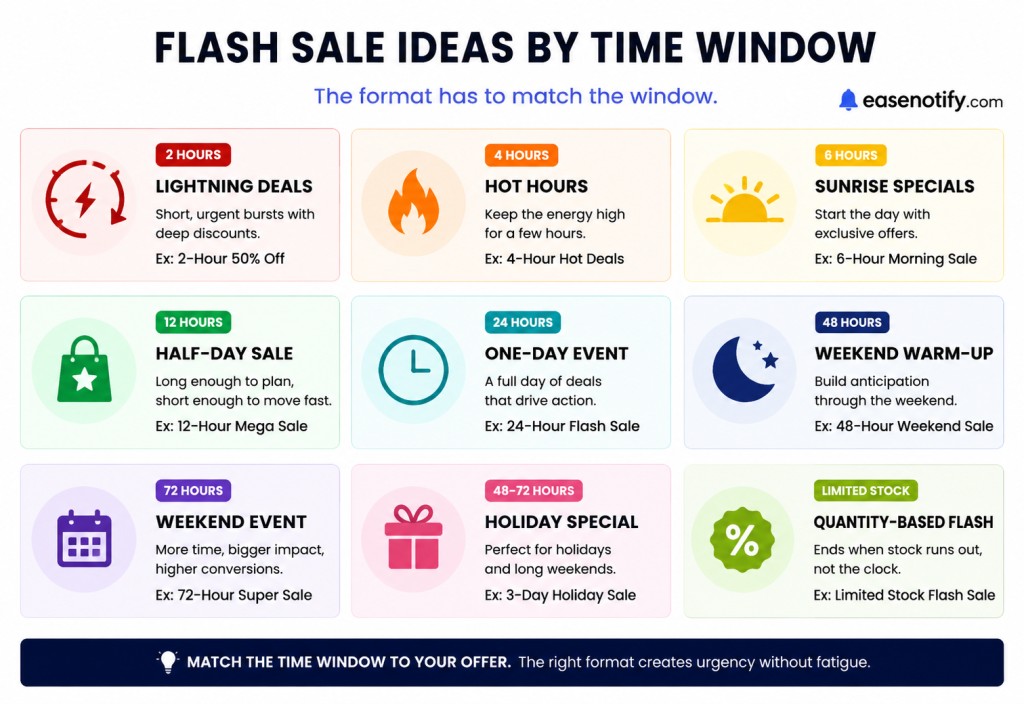
Most flash sale ideas fail for a boring reason: the format does not match the time window. A 40% doorbuster needs a 4-hour window to feel electric. A bundle deal needs 48 hours to let word spread. This guide gives you 9 flash sale ideas, each matched to the window where it performs, with the announcement copy to run it.
Key Takeaways
- A flash sale is a steep, short-window promotion. Most effective windows run between 4 and 48 hours.
- The window and the format must match: deep discounts suit short windows, structured offers like BOGO suit longer ones.
- “Ends tonight at midnight” outperforms “limited time offer” because a concrete deadline is verifiable.
- On-site announcement is the highest-leverage channel: it reaches every visitor, including the majority not on your email list.
- Run flash sales no more than once or twice a quarter. Frequency destroys the scarcity that makes them work.
What Is a Flash Sale?
A flash sale is a promotion that offers a significant discount on selected products for a deliberately short window, usually between a few hours and 48 hours. The compressed timeline creates urgency: the shopper cannot defer the decision to next week because the offer will not exist next week.
The mechanism is loss aversion. As Harvard Business School professor Gerald Zaltman’s research popularized, 95% of purchasing decisions are subconscious, and the fear of missing a closing window is one of the strongest subconscious motivators in commerce. The full psychology is covered in our pillar on urgency marketing for DTC brands.
Why Do Most Flash Sales Underperform?
Three failure modes account for almost every flat flash sale.
The window is wrong for the format. A 15% discount running for 72 hours is not a flash sale, it is a coupon. Mailchimp’s flash sale guidance puts effective durations at 24 hours or less for most formats, and stretching a weak offer over days removes the only thing that made it interesting.
Nobody on-site knows it is happening. Stores announce flash sales by email and social, then leave the website silent. But email reaches only subscribers. Every visitor during the window should hit an unmissable announcement within the first second on any page.
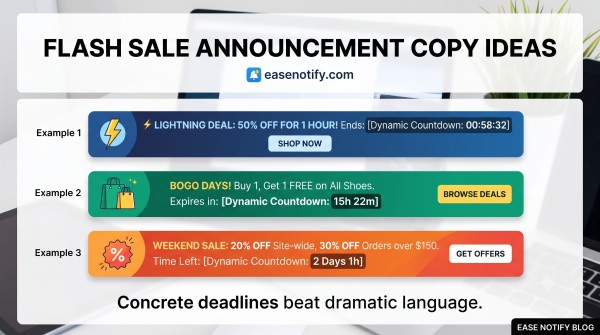
The deadline is vague. “Limited time offer” is wallpaper. “Ends tonight at 11:59 PM” is a fact the shopper can check against their watch. Concrete beats dramatic.
9 Flash Sale Ideas Matched to Their Time Window
Lightning window: 2 to 6 hours
1. The lunch-break lightning deal. One hero product at your deepest discount of the year, live for 4 hours mid-day. Copy: “4 hours only: 40% off the [product]. Gone at 4 PM.” Pair the bar with a live countdown so the window is visible, not claimed.
2. The flash drop. Instead of discounting old stock, release a new or restocked product at launch pricing for a few hours. Bean Box popularized this pattern by discounting new collections instead of clearance, as documented in Drip’s flash sale examples. Scarcity of access, not price, is the hook.
Standard window: 12 to 24 hours
3. The 24-hour category takeover. One category, one day, one deep discount. Rotating the category across a multi-day event keeps repeat visitors checking back daily.
4. The BOGO day. Buy one, get one free or half off, for 24 hours. BOGO protects margin better than a straight 50% because it moves two units. State the math plainly in the bar: “Today only: buy one, get one 50% off. Ends midnight.”
5. The threshold flash. “Today only: free express shipping on orders over $75.” This one raises average order value while it converts, and it costs a shipping subsidy instead of margin. It pairs naturally with the discount and free-shipping copy in our guide to announcement bar templates.
6. The cart-saver flash. Target only visitors with items in cart: “Complete your order in the next 6 hours and save 15%.” With EaseNotify’s Page Targeting, the message shows only on cart and checkout pages, which keeps the discount away from shoppers who would have paid full price.
Extended window: 48 to 72 hours
7. The weekend warm-up. Friday evening to Sunday midnight, tiered by day: 30% Friday, 20% Saturday, 10% Sunday. Descending discounts reward early action and keep urgency alive across the whole window.
8. The bundle-more-save-more event. Blume’s 40% bundle sale is the reference case here, per Wisepops’ flash sale research: discounts scale with bundle size across a weekend window that gives shoppers time to compose larger carts.
9. The last-chance clearance sprint. 48 hours to clear discontinued lines, framed honestly: “These 12 products are retiring. 50% off until Sunday, then gone for good.” Truthful finality is the strongest urgency there is.
How Do You Announce a Flash Sale On-Site?
The announcement is half the sale. Here is the stack that covers every visitor.
A sitewide bar with a countdown. The Sticky Widget keeps the offer and its deadline visible while shoppers scroll, and a live timer makes the window concrete. Our breakdown of Shopify countdown timer placements covers the five spots that work and the two that backfire.
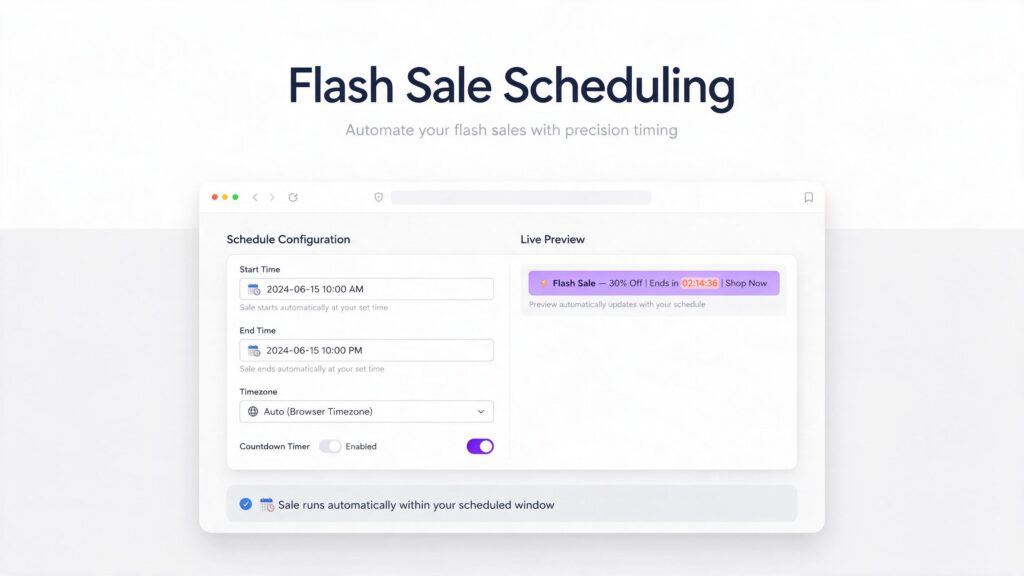
Scheduled start and stop. A flash sale bar that lingers after the deadline kills your credibility for every future sale. EaseNotify’s Scheduling Widget starts and stops the message on the clock, so the window is enforced by the tool, not by whoever remembers to log in.
A dismissal that sticks. Shoppers who close the bar have seen the offer. Remember Dismissal keeps it closed for them, and the Auto-close Widget can retire the message in long sessions. Urgency should never turn into nagging.
Page-level variants. Run the sitewide offer everywhere, and a cart-specific completion nudge only where carts exist. This is standard announcement bar practice applied at flash speed.
EaseNotify is a website notification and announcement bar tool for Shopify and web businesses, and flash sales are the sharpest version of the problem it solves: the right message, on the right page, for exactly the right window.
Frequently Asked Questions (FAQs)
Q: How long should a flash sale last? A: Between 4 and 48 hours depending on format. Deep single-product discounts work best in 4 to 6 hour windows, sitewide or BOGO offers suit 24 hours, and bundle or clearance events can stretch to 48 or 72 hours before urgency decays.
Q: How often should I run flash sales? A: Once or twice per quarter. Run them monthly and customers learn to wait for the next one, which cannibalizes full-price revenue. Scarcity of the event itself is part of what makes each sale convert.
Q: What discount percentage works best for a flash sale? A: Short windows need discounts that feel like an event, usually 30 to 50% on featured items. For longer windows, use structured offers like BOGO or bundle tiers, which protect margin while still reading as significant.
Q: How do I promote a flash sale without a big email list? A: Announce it on-site with a sitewide bar and countdown timer, since that reaches every visitor from any traffic source. Add organic social posts before and during the window. On-site announcement is the only channel that covers 100% of live shoppers.
Q: Do countdown timers actually work for flash sales? A: Yes, when the deadline is real. A visible timer makes the window verifiable and concrete, which outperforms vague “limited time” language. Fake or resetting timers destroy trust and can violate consumer protection rules in some regions.
Pick one idea, match it to its window, and put the deadline on every page. EaseNotify handles the announcement side: scheduled bars, live countdowns, page targeting, and polite dismissal controls, free to start and $6 per month for Pro.
Start your free EaseNotify plan at easenotify.com.
1 thought on “Flash Sale Ideas: 9 Formats Matched to the Sale Window That Makes Them Work”